Commercial Towel Service: How It Works, What It Costs and How to Choose a Provider
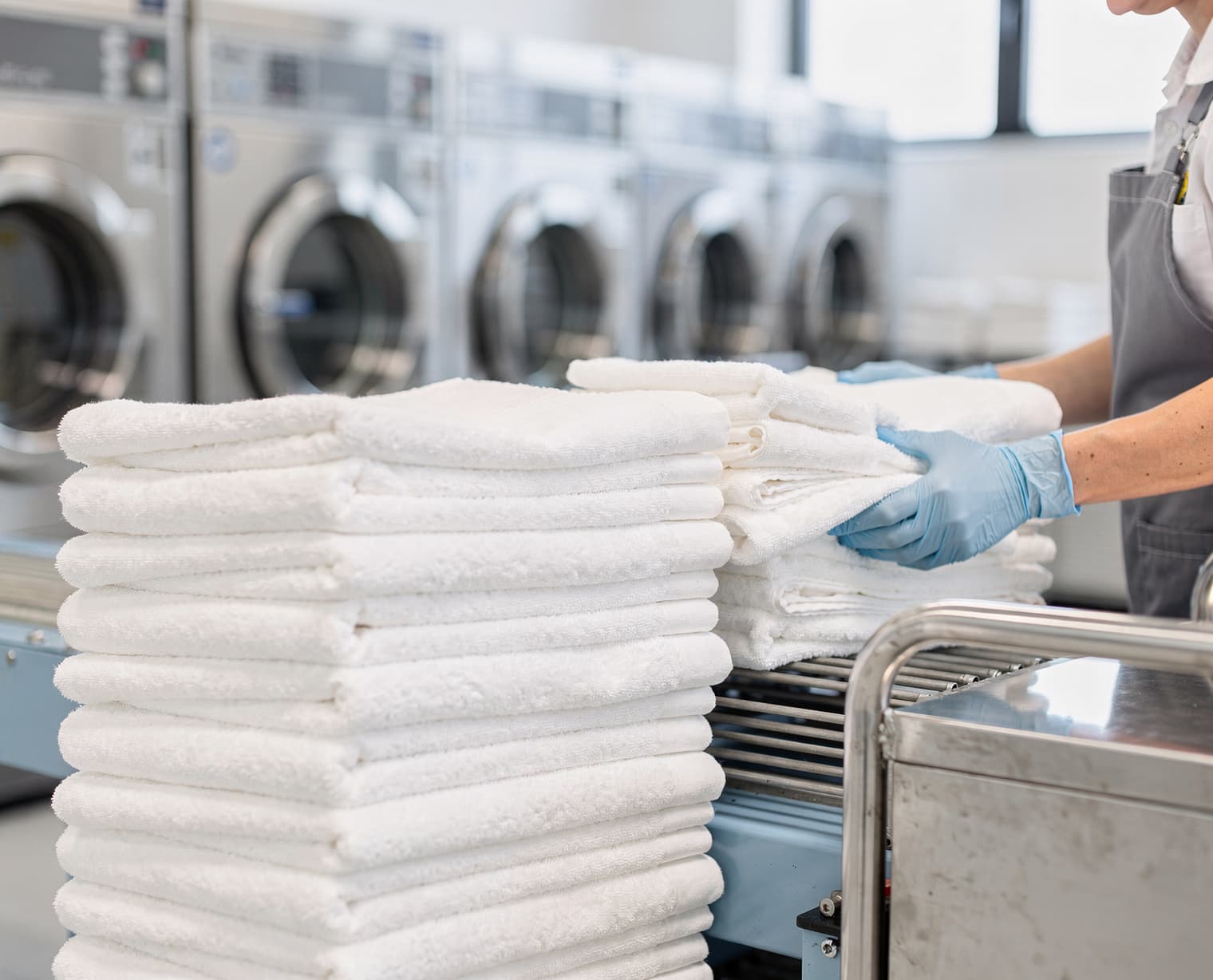
Table of contents
- What is towel service?
- Which towels a commercial program covers
- Towel rental vs. laundering towels you own
- How a towel service works week to week
- How much does towel service cost?
- Hygiene standards that apply to towels
- Which towel service companies serve healthcare and hospitality businesses?
- How to choose a towel service provider
- Frequently asked questions
A commercial towel service delivers clean towels to your business on a fixed schedule, collects the soiled ones, launders them at a commercial plant and brings them back the following week. That sounds simple, and at a route level it is. The decisions underneath it are not: whether to rent the towels or have your own laundered, how many you need on hand, what a fair price looks like once service charges and replacement fees are counted, and how you tell a plant that can prove its towels are hygienically clean from one that just says so. This guide covers each of those decisions for the businesses that use towels hardest: hospitals and clinics, restaurants and bars, hotels, gyms, spas and salons.
What is towel service?
Towel service is a recurring rental-and-laundering program in which a commercial laundry supplies towels, picks them up when soiled, processes them and redelivers them on a route schedule, usually weekly. You pay a per-piece rate (or a per-pound rate if you own the goods) rather than buying towels, staffing a laundry room and running washers and dryers yourself. The service provider owns the inventory in a rental program, so worn or lost towels are replaced from its stock instead of your capital budget.
A towel program can also ride on the same truck as the rest of a linen service: table linen and aprons for a restaurant, sheets and gowns for a clinic, mats and restroom paper for any facility. That matters for cost, because the stop charge and route labor are already paid for once the truck is coming.
Which towels a commercial program covers
"Towel" means something different in a surgery center than behind a bar. The table below shows what each type of business typically puts on a towel program and what the towels have to do.
| Business | Towels on the program | What the towel has to do |
|---|---|---|
| Hospitals, surgery centers, clinics | Bath towels, hand towels, washcloths, bath blankets | Meet healthcare hygiene standards, arrive packaged and stay at par level |
| Restaurants, bars, caterers | Bar towels, kitchen towels, low-lint glass towels, heavy grill wipes (see our restaurant towel service notes for owners) | Absorb, survive sanitizer buckets and grease, and not shed lint on glassware |
| Hotels | Bath, hand and washcloth sets plus pool, fitness-room and spa towels | Match in weight and whiteness room to room; flex with occupancy |
| Gyms, spas, salons, massage practices | Gym and spa towels (our gym towel service guide covers rental vs. in-house costs), salon towels, massage towels and sheets | Hold up to color, oil and product; return soft; come back in volume on busy days |
| Industrial, HVAC, automotive | Shop and cleaning towels | Absorb solvents and grease; be laundered rather than thrown away |
Towel rental vs. laundering towels you own
There are three ways to keep a business in clean towels, and the right one depends on how much control you want over the product and how much capital you want tied up in it.
Rental (the provider owns the towels)
The laundry supplies towels from its inventory, you pay a weekly rate per piece, and the provider absorbs normal wear and replaces worn-out pieces. This is the model behind our restaurant, healthcare, gym and spa towel programs. You never buy a towel, and inventory grows or shrinks with your par level. The trade-off is less control over exact brand or weight, and replacement charges for towels that leave the building and do not come back.
Customer-owned goods (you buy, the provider launders)
Some hotels and healthcare systems buy their own towels to a specification and pay a laundry to process them, usually by the pound. You control the product; you also carry the capital cost, the shrinkage and the replacement purchasing. Per-pound pricing is common here, and this is what a towel laundry service or towel cleaning service usually means as distinct from towel rental.
On-premise laundry
Running your own washers works for some hotels and large hospitals with the space, staff and utilities to do it. The costs are equipment, labor, chemicals, hot water and the opportunity cost of staff folding towels instead of serving guests or patients. The CDC's environmental infection control guidelines note that laundries are typically the largest users of hot water in hospitals, consuming 50% to 75% of the total, which is a meaningful utility line before you add staffing. Our on-premise laundry (OPL) to service guide walks through that comparison in more detail.
How a towel service works week to week
- Program design. A route or account representative surveys your volume by item and sets a par level: enough clean towels on hand to cover the gap between deliveries, plus a buffer for a heavy week. For a bar, that is a count of bar towels per shift; for a clinic, it is towels and washcloths per exam room or bed.
- Scheduled delivery. Clean, packaged towels arrive on a set day on a fixed weekly route, ideally with the same driver each week. Frequency is matched to your volume; healthcare accounts run on fixed schedules with weekend and holiday coverage agreed up front.
- Soiled pickup. Soiled towels are bagged or carted and collected on the same stop. In healthcare, that means closed, labeled bags or carts, with no sorting or rinsing at the point of use; the CDC guidance notes that OSHA prohibits sorting or rinsing contaminated laundry where the contamination occurred.
- Processing. At the plant, towels are sorted, washed by a formula matched to the soil (grease and sanitizer on bar towels, body fluids on healthcare towels), extracted, dried and inspected. Stained or thin pieces are pulled, which is called ragout, and replaced.
- Inventory review. The counts of what went out, what came back and what was ragged out are the data a provider should review with you. We put proprietary inventory-tracking software in front of our clients and sit down monthly to go through usage, short weeks, upcoming events and seasonal swings, then reset par levels and delivery frequency so you are not paying for towels that sit in a closet.
How much does towel service cost?
Towel service cost depends on four things: the towel type and grade, your weekly volume, how often the truck stops and what the service charges on top of the piece rate look like. We do not publish a single rate card because those variables move the price too much; our linen rental pricing guide explains why. What follows are published reference points so you can sanity-check a quote.
Rental pricing per towel
- Shop towels are priced in cents per piece per week. A public-agency rental agreement with Cintas lists red shop towels at $0.06 per towel on a 60-month term, and a county procurement schedule from UniFirst lists a 16-by-27-inch towel at $0.11 per unit. A Tarrant County, Texas bid award shows 18-inch shop towels at $0.25 to $0.40 each, a municipal bid price that sits well above the industrial-laundry averages and illustrates how far pricing can spread by market.
- Bath, hand and gym towels are quoted per piece as well. Published rates for gym and bath-type towels run roughly $0.13 to $0.70 per towel per week; we quote our own pricing per program. Healthcare-grade processing adds cost over hospitality processing because of the documentation, testing and handling controls involved.
Per-pound pricing for customer-owned towels
If you own the towels, commercial laundering is quoted by the pound and swings with geography and volume. One commercial laundry's published guide puts typical routed rates at $0.75 to $1.10 per pound including pickup and delivery, lower at high volume; the same operator's bulk pricing comparison shows rates as high as $1.75 to $3.50 per pound in large urban markets. Treat these as examples rather than benchmarks, and ask any provider quoting by the pound to convert the quote to a per-piece figure so you can compare it with rental quotes.
The charges that sit under the piece rate
The per-towel rate is the number everyone compares. The lines below are where two quotes with the same rate end up far apart over the life of the contract.
| Line item | What it is | What to ask |
|---|---|---|
| Minimum stop or weekly minimum | A floor on each delivery regardless of volume; a statewide cooperative contract with Cintas lists a $35 minimum stop | Does my volume clear it every week, including slow weeks? |
| Service, fuel, energy or environmental charges | Percentage or flat add-ons to the invoice | Are they fixed, or can they move mid-contract without notice? |
| Loss, damage and replacement | Charges for towels that are not returned or are ruined (bleach, paint, grease beyond washing) | What is the replacement price per towel, and how is a loss counted? |
| Inventory or product charges | Fees to maintain or refresh the towel pool | Is this included in the rate or separate? |
| Annual increases | Scheduled or discretionary rate adjustments | Capped at what, and with how much notice? |
We write our proposals with the towel rate, service charges and replacement pricing on the same page, and we hold to consistent line items from cycle to cycle, with any change explained before it appears on an invoice. Ask every provider you talk to for the same thing in writing; the ones that will not put it on paper have told you something.
Hygiene standards that apply to towels
A towel is the textile most likely to touch skin, a wound, a glass or a food-prep surface, so the processing standard behind it matters more than it does for a tablecloth.
Healthcare towels
The CDC guidelines describe hygienically clean laundry as the goal: textiles rendered free of vegetative pathogens through a combination of dilution, detergent, heat and chemistry. They cite hot-water washing at a minimum of 160°F (71°C) for at least 25 minutes as the commonly recommended parameter, with chlorine bleach adding a margin of safety, and they accept validated low-temperature formulas that rely on monitored chemistry. Two independent bodies verify that a plant actually does this:
- HLAC (Healthcare Laundry Accreditation Council) is a nonprofit that inspects and accredits laundries processing reusable textiles for hospitals, nursing homes and other healthcare facilities against standards for patient safety and infection prevention. Accreditation means the laundry passed an inspection of its facility, policies and procedures, training programs and its relationships with healthcare customers.
- TRSA Hygienically Clean Healthcare adds outcome testing. Certified plants must pass qualifying microbiological tests, document best management practices in a quality assurance manual, pass an on-site audit, and then submit to quarterly RODAC testing (no more than 20 CFU per square decimeter for healthcare) and semi-annual USP 62 pathogen screening.
Put simply, HLAC verifies the process; Hygienically Clean verifies the outcome. Economy Linen Hospital Services has been HLAC accredited since 2007, both our production plants are TRSA Hygienically Clean certified, and our hospital linen is tested quarterly by an independent accredited lab with RODAC plates plus USP 62 pathogen screening twice a year; recent results are available to clients on request. If a provider tells you its towels are "medical grade" but cannot name the accreditation or show a test report, treat that as a no.
Restaurant and bar towels
State food codes modeled on the FDA Food Code govern wiping cloths in kitchens. In Ohio, for example, the Uniform Food Safety Code requires laundered linens to be stored in a clean, dry location, protected from splash and contamination and at least six inches off the floor, and cross-references the rule on storing wiping cloths in sanitizing solution. A rental program handles the laundering half of that rule for you; your staff still has to manage sanitizer buckets and storage on site. Separately, TRSA offers a Hygienically Clean Food Service designation for plants serving restaurants, which is a reasonable thing to ask a restaurant linen supplier about.
Which towel service companies serve healthcare and hospitality businesses?
The market splits into three groups, and each is a legitimate fit for a different kind of buyer.
- National uniform and facility-services companies. Cintas, Alsco Uniforms, Vestis (formerly Aramark Uniform Services) and UniFirst run towel programs as part of broad route offerings that include uniforms, mats, mops and restroom supplies. Their strengths are footprint and consistency for multi-state accounts; their contracts tend to be multi-year with automatic renewal unless you give notice in a defined window. Alsco's published terms of service, for instance, state that service renews automatically at then-current rates unless the customer turns auto-renewal off. Read the term, the notice period and the price-adjustment clause before signing with any of them.
- Healthcare specialists. ImageFirst is a healthcare-focused linen and garment provider. If your only linen need is clinical, a specialist is worth a quote.
- Regional independents. In our part of the Midwest this includes providers such as Miller's Textiles, Buckeye Linen, Morgan, Domestic Uniform, City Uniform, Comtex and us. The case for a regional company is local account support and programs built around your facility rather than a standard route. Ask any provider, national or regional, for its plant credentials and test results before weighing price.
Our own answer to that question: we have operated since 1931 out of Dayton, Ohio, and today run two production plants that are both TRSA Hygienically Clean Healthcare and Clean Green certified, with HLAC accreditation on the healthcare side, serving Cincinnati, Columbus, Dayton, Zanesville and Middletown in Ohio; Indianapolis, Bloomington and Lafayette in Indiana; and Northern Kentucky, with local route representatives and the same driver each week. Our towel customers range from surgery centers and eye clinics to fitness centers, massage practices and banquet halls, which is the mix a regional plant should be able to show you.
How to choose a towel service provider
Use these eight checks in order. The first three screen out providers that cannot do the job; the rest separate a good contract from an expensive one.
- Verify the plant's credentials for your industry. Healthcare: HLAC accreditation and TRSA Hygienically Clean Healthcare, with test results available. Restaurants and hotels: Hygienically Clean Food Service or Hospitality, or at minimum a documented wash process and third-party testing. Ask which plant will process your towels, since a company can hold a certification at one facility and not another.
- Look at the towels. Ask for samples of the actual rental stock you will receive, not a catalog photo. Check weight, lint on glass towels, softness on bath towels and whether the pool is graded so a fine-dining bar is not getting towels ragged out of a garage program.
- Confirm the route fits your hours. A restaurant does not want a truck at the back door during Friday dinner service; a surgery center needs delivery before the first case. Ask about the delivery window, what happens when you run short between stops, and whether the same driver services your account.
- Get every charge in writing on one page. Piece rate, minimum, service and energy charges, replacement pricing, inventory fees and the increase clause. If any of them are "to be determined" or "per local pricing," ask for a number.
- Read the term and the renewal clause. Know the contract length, the notice window to cancel and whether the agreement rolls over automatically. Put the notice date on your calendar the day you sign.
- Ask how inventory is tracked and reviewed. A provider that counts out and counts in, shows you the data and meets with you about it will catch over-stocking and loss before they compound. A provider that just drops bundles will not.
- Check what else can ride on the truck. Mats, mops, restroom paper, janitorial supplies, uniforms and aprons on one account and one invoice reduces vendors and usually lowers the per-stop cost of the towel program itself.
- Ask about environmental practices. A plant that reuses rinse water, recovers heat and routes trucks efficiently is also a plant that controls its costs. TRSA's Clean Green certification is the recognized benchmark; we are Clean Green certified and use 0.7 gallons of water per pound processed.
For healthcare buyers, our medical linen vendor checklist expands these points into the questions an infection preventionist will want answered.
Frequently asked questions
How often does a towel service deliver?
Weekly is the baseline. Higher-volume accounts get more frequent service, and frequency can change with the season or, for hotels, with occupancy. Deliveries and soiled pickups happen on the same stop.
Is towel rental cheaper than buying towels and washing them in-house?
It depends on your volume. Count labor, utilities, chemicals, equipment and replacement purchasing against the rental rate and run a side-by-side comparison with your actual numbers. Our OPL-to-service guide walks through that comparison.
What happens if towels are lost or damaged?
Normal wear is the provider's cost in a rental program. Towels that are not returned or are destroyed by bleach, paint or heavy grease are billed at a replacement price that should be stated in your agreement. Accurate counts at pickup and delivery are what keep that line from becoming a dispute.
Can a towel service handle healthcare and restaurant towels from the same provider?
Yes, if the plant is credentialed for both. Healthcare towels require accredited processing and separate handling; restaurant towels need a wash formula built for grease and sanitizer. A regional provider with HLAC and TRSA Hygienically Clean certification can serve a hospital and the restaurant across the street on the same route.
How do I get a towel service quote?
Count your towels by type per week, note your delivery-day constraints and any hygiene requirements, and ask for a proposal that lists the piece rate, minimums, service charges and replacement pricing together. You can request a customized quote from us or call 800-536-1000 for customized pricing and options for your business.
Ready to get started?
Talk to our team and see how we can help.