HLAC-Accredited Healthcare Laundry in Columbus, Ohio: How We Process Hospital and Clinic Linens
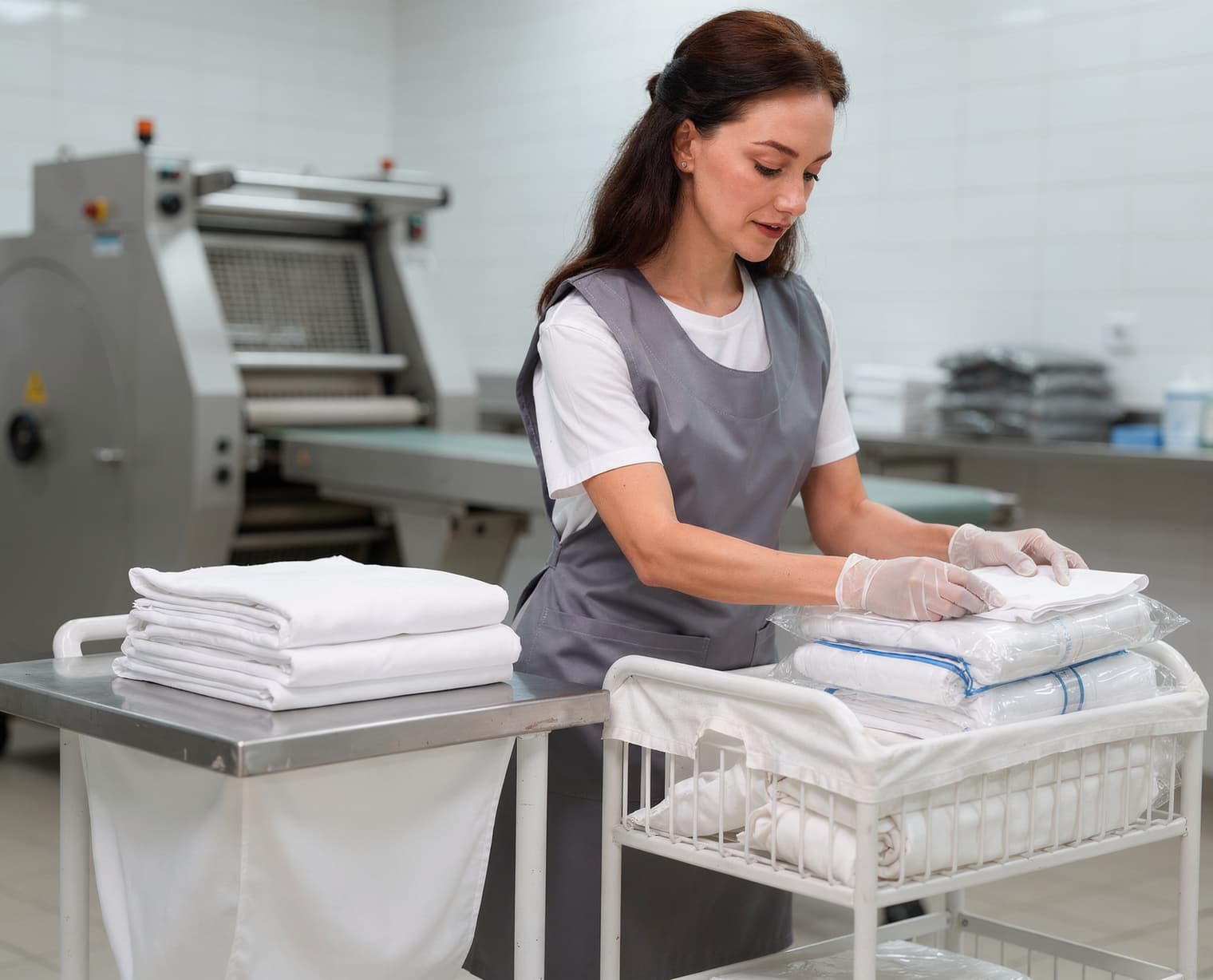
Table of contents
Economy Linen and Towel Service is an HLAC-accredited healthcare laundry serving Columbus and central Ohio. Our hospital linen operation was first accredited by HLAC in 2007, one of the first hospital laundries to earn it, and both of our production facilities also hold TRSA Hygienically Clean Healthcare certification, which adds ongoing microbial testing of finished textiles to the inspection-based HLAC standard. We serve Columbus hospitals, surgery centers, urgent cares, dialysis units, imaging centers and physician and dental offices from our distribution center at 5233 Trabue Road, with processing at accredited production facilities, including our Zanesville plant, which has been dedicated to hospital linen since 1990. Any facility can confirm a laundry's current status on the HLAC accredited laundries directory, which can be filtered by state.
Accreditation is a floor, not a description of how a laundry runs. So this article covers what the Healthcare Laundry Accreditation Council (HLAC) standard requires, how we process hospital and clinic linens against it, and what to ask any laundry before you sign.
What HLAC accreditation actually covers
HLAC's Accreditation Standards for Processing Reusable Textiles for Use in Healthcare Facilities are not a wash formula. They are a plant-wide operating standard covering the full chain of custody, from the soiled-linen chute at your facility to the clean cart arriving on your unit. The main requirements:
- Functional separation. Soiled and clean textiles must never occupy the same space. Separation is achieved by physical barriers or defined spatial separation, both inside the plant and in delivery vehicles that carry both streams.
- Air pressure differentials. The soil-sort area must be under negative pressure relative to clean areas, with exhaust vented outdoors, so airborne lint and contaminants move away from finished goods rather than toward them.
- Wash process controls. Hot-water washing with detergent at 160°F (71°C) or above for at least 25 minutes, or a validated low-temperature process using a chemical disinfectant at the manufacturer's specified concentration. This mirrors the CDC's environmental infection control guidance for laundry, which also notes that chlorine bleach at 50–150 ppm provides an extra margin of safety in low-temperature cycles.
- Textile handling. Soiled items travel in fluid-resistant, leak-proof bags or containers; carts and liners that become soiled are cleaned and disinfected before reuse.
- Employee training. Staff are trained on standard precautions, bagging and cart handling, and cleaning of vehicles and work surfaces.
- Inspection cycle. HLAC conducts an on-site survey at least once every three years, and the laundry must stay in compliance throughout, not just on inspection day.
Why this matters to a hospital administrator: neither The Joint Commission nor CMS publishes its own detailed laundry standard. The Joint Commission's guidance directs organizations to build linen policies on evidence-based sources such as the CDC, and CMS hospital survey worksheets check that laundry is processed consistently with the hospital's infection-control policy and that soiled textiles are bagged at the point of collection with minimal agitation. An HLAC-accredited vendor gives your infection preventionist a documented, third-party-verified answer to those questions rather than a vendor brochure.
"HLAC-aligned" versus "HLAC-accredited"
You will see both phrases in proposals. "Aligned" or "follows HLAC standards" means the laundry says it operates to the standard. "Accredited" means HLAC inspectors have surveyed the plant, found it compliant, and listed it publicly. Only the second is verifiable. If a proposal says "aligned," ask for the accreditation certificate and the plant address it covers, then check the HLAC directory. HLAC's assessment is an on-site survey of a specific laundry, and the directory lists plants by address, so confirm the certificate names the facility that will actually wash your linen, not a corporate headquarters or a different branch.
How we process hospital and clinic linens
Each step below maps to a clause of the standard.
1. Soiled pickup and transport
HLAC requires soiled textiles to travel in fluid-resistant, leak-proof bags or containers and, where a vehicle carries both streams, to be kept functionally separate from clean linen, with cargo areas cleaned regularly and whenever visibly soiled. Our accreditation covers this stage of the chain of custody, not just the wash floor. Soiled healthcare linen is processed at our accredited production facilities; our Zanesville plant has focused strictly on hospital linen for large medical facilities since 1990, and keeping healthcare textiles in a dedicated healthcare operation, rather than mixing them with restaurant or industrial work, simplifies both separation and traceability.
2. Soil sort under functional separation
Soiled linen enters a soil-sort area separated from the clean side by strict physical barriers; clean and used linens never cross paths. Staff separate soiled items by type so each classification receives the wash temperature and formula it needs. Every batch is tracked from this point through delivery.
3. Wash: time, temperature and chemistry, monitored
Each classification runs a wash formula that is monitored for time, temperature and chemical levels, using hospital-grade detergents at high temperatures. The monitoring is the point: the CDC and HLAC parameters only protect patients if the equipment hits them on every load, and a documented record of each cycle is what an infection preventionist or an HLAC inspector will ask to see. Our formulas are also built for water and energy efficiency; the plant runs at roughly 0.7 gallons of water per pound of linen, and heat is recovered from drained hot water. That efficiency is why both plants hold TRSA Clean Green certification alongside the hygiene credentials.
4. Finishing, inspection and rejection
After drying and ironing or folding, each item is inspected by hand, and anything that does not meet our standards does not leave the building. For a surgery center or hospital unit, this is the step that decides whether your staff spend time culling ragged gowns on the floor or not. Our hospital linen procedures are written to exceed HLAC's cleanliness requirements, not merely meet them.
5. Packaging and clean delivery
Finished linen is wrapped or covered in sanitary conditions to prevent recontamination during staging, transport and storage at your facility. That packaging is what Brad Childers of Nationwide Children's Hospital singled out in his feedback on our service: "the very high cleanliness of the Linen and packaging," alongside on-time deliveries. Clean product is routed through our Columbus distribution center for delivery across the metro and outlying communities including Dublin, Gahanna, Grove City, Circleville, Marion, Mt. Vernon and Chillicothe.
6. Third-party microbial testing
HLAC verifies process; TRSA Hygienically Clean Healthcare verifies outcome. Under TRSA's healthcare standard, certified laundries submit finished textiles for microbiological testing (USP 62 and RODAC plate methods) and undergo on-site inspection of their quality assurance documentation and critical control points, with re-inspection every three years. Holding both credentials means an independent lab is periodically confirming that what leaves our plant is, in fact, hygienically clean, not just that our procedures are correct on paper.
What you actually receive in Columbus
Our medical linen program covers the textile categories a hospital, ASC or clinic runs through daily: patient and IV gowns in infant through bariatric sizing, isolation gowns, sheets and pillowcases, bath blankets, thermal and receiving blankets, incontinent pads, bath and hand towels and washcloths, and scrubs and lab coats for staff, with specialty apparel for mammography and OB/GYN settings. The program is rental, so you are not buying inventory, and in our scrub program worn garments leave service automatically rather than accumulating in your closets.
Processing is half the service. The other half is whether your units have the right quantities on the right days without over-stocking. We provide proprietary inventory software that tracks linen movement through your facility and sit down with each hospital account monthly to review usage and adjust par levels. Those reviews are where we look for cost reduction: departments that hoard, items that walk out the door, and categories where a different product would cut weight or loss.
Invoicing follows the same principle. We think a linen invoice should have consistent cycle-to-cycle pricing, plainly labeled line items, and advance notice before anything changes; we wrote up what to look for in a linen invoice if you are comparing proposals. Healthcare accounts tend to stay with us: Eye Center of Columbus has used us for more than 13 years, and St. Elizabeth Surgery Center describes our local team as responsive and reliable after seven years of service.
Questions to ask any healthcare laundry before you sign
The right choice of vendor depends on your volume, product mix and how much account support you want. Whichever vendors you evaluate, these questions separate a compliant operation from a well-run one:
- Which plant will process our linen, and is that specific plant HLAC-accredited? Confirm the address against the HLAC directory. Ask when the last survey was.
- Do you also hold TRSA Hygienically Clean Healthcare, and can we see recent microbial test results? Process inspection and outcome testing are different assurances; the best answer is both.
- How do you document time, temperature and chemistry for each wash cycle? You want automated logs your infection preventionist can review, not a verbal assurance.
- How are soiled and clean loads separated in your trucks? Transport is covered by the HLAC standard but rarely spelled out in a proposal unless you ask.
- What is your inspection and rejection process, and what happens to a rejected item? Ask what percentage is pulled and how replacement is handled and billed.
- How will you help us manage inventory and usage? Ask for the review cadence, what data you will see, and who owns par-level changes.
- What is on the invoice besides the per-piece or per-pound rate? Ask whether fuel, energy, environmental or replacement charges appear separately, and get the answer in writing.
- Who answers the phone locally? A Columbus route representative and service manager you can reach directly matter more than a national call center.
If you would like to put those questions to us, our Columbus team can be reached at 614-870-6400, or you can request a proposal and we will build a program around your actual census and product mix rather than a standard route.
Frequently asked questions
Is Economy Linen HLAC accredited?
Yes. Our hospital linen operation was first accredited by HLAC in 2007 and remains accredited, and both of our production facilities are TRSA Hygienically Clean Healthcare and TRSA Clean Green certified. You can verify current status on the HLAC accredited laundries directory.
Where are Columbus hospital linens processed and delivered from?
Healthcare linen is processed at our HLAC-accredited, TRSA Hygienically Clean Healthcare certified production facilities, including our Zanesville plant, which has been dedicated to hospital linen since 1990. Clean product for Columbus and central Ohio accounts is delivered through our Columbus distribution center on Trabue Road.
Does HLAC accreditation satisfy Joint Commission or CMS requirements for linen?
Neither body publishes a stand-alone laundry standard; both expect hospitals to have linen-handling policies grounded in evidence-based guidance such as the CDC's. Using an HLAC-accredited laundry gives you third-party verification that your vendor's processes meet those CDC-based parameters, which is documentation surveyors can review.
What is the difference between HLAC and TRSA Hygienically Clean?
HLAC accredits the laundry's processes and facility design through on-site inspection against its published standards. TRSA Hygienically Clean Healthcare adds laboratory microbial testing of finished textiles to a documentation and inspection audit. HLAC confirms the process is right; Hygienically Clean confirms the output is clean.
What types of Columbus healthcare facilities do you serve?
Hospitals, surgery centers, urgent care clinics, dialysis units, imaging centers, and physician and dental offices across Columbus and surrounding communities including Dublin, Gahanna, Grove City, Marion, Mt. Vernon, Circleville and Chillicothe, as well as retirement communities across our wider service area.
Ready to get started?
Talk to our team and see how we can help.