What Is a Linen Service? How Commercial Linen Rental Works
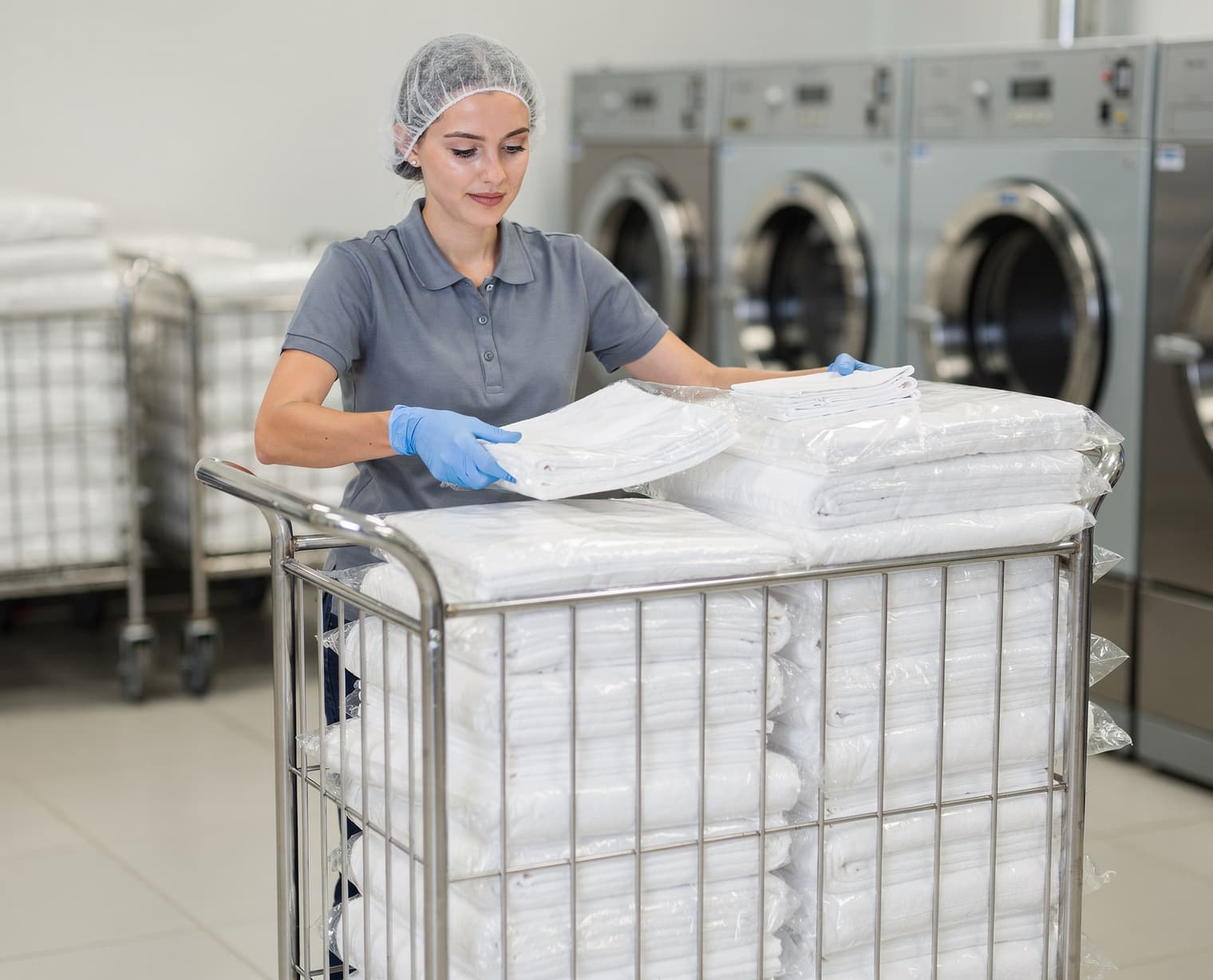
Table of contents
- What does a linen service include?
- How linen rental works, step by step
- Linen rental vs. a linen cleaning service for goods you own
- What drives the price of a linen service
- Why healthcare and food service linens are processed differently
- How to choose a local linen company near you
- Frequently asked questions
- Next step
A linen service is a company that owns, launders and delivers the textiles a business uses every day, so the business never has to buy, wash, fold or replace them. Instead of running washers in a back room or sending staff home with aprons, you pay a set rate for clean napkins, tablecloths, towels, sheets, patient gowns, scrubs or uniforms to arrive on a route truck each week, and the soiled ones leave on the same truck. If you are looking for linen rental near me and want to know what you would actually be signing up for, this guide covers what is included, how the weekly cycle works, how rental differs from cleaning linens you already own, and what to check before choosing a local linen company.
What does a linen service include?
Most people picture a laundry. A commercial linen service is closer to a managed inventory program with a laundry attached. The core of it is four things:
- The linens themselves. In a rental program the service owns the inventory. It buys the goods, stocks enough to cover your usage plus a reserve, and retires and replaces items as they wear.
- Laundering to a defined standard. Commercial plants wash by product type and soil level, with wash chemistry, water temperature and finishing (ironing, steaming or folding) set for each item. For healthcare and food service, that process is audited and microbially tested by third parties, which we cover below.
- Scheduled pickup and delivery. A route representative on a fixed schedule drops clean goods, collects soiled goods and restocks to an agreed level.
- Account management. Someone tracks what you use, adjusts quantities as your volume changes and handles shortages, damage and seasonal swings.
What goes on the truck depends on the industry. The table below shows the typical product mix in the two industries we serve most, drawn from our own hospital linen, restaurant linen and uniform programs.
| Business type | Typical rental items | Often added to the same route |
|---|---|---|
| Hospitals, surgery centers, clinics, long-term care | Sheets, pillowcases, bath blankets, thermal blankets, bath and hand towels, washcloths, patient gowns (infant to bariatric), IV and specialty gowns, isolation gowns, incontinence pads | Scrub sets, lab coats, staff apparel, floor mats, restroom paper and soap |
| Restaurants, bars, caterers, banquet centers | Napkins and tablecloths in a range of colors and sizes, bar towels, kitchen towels, aprons | Chef coats, cook and server uniforms, entrance mats, mop service, restroom supplies |
| Hotels, spas, salons, gyms | Bed linens, bath towels, massage and salon towels | Housekeeping uniforms, mats, paper products |
| Industrial, HVAC, construction, manufacturing | Uniforms for HVAC, plumbing, construction and manufacturing crews | Mats, mops, restroom and janitorial supplies |
Because our route is already stopping at your door, we also carry facility products such as mats, mops and restroom paper, and we add janitorial supplies through our Premier Janitorial division for the same reason: one delivery, one invoice.
How linen rental works, step by step
The mechanics are the same whether you run a 30-table bistro in Columbus or a surgery center in Indianapolis. Here is the sequence we follow, which is representative of how a professional linen service sets up any account.
- Needs analysis. Before anyone quotes a price, a representative reviews the operation with you and documents which items you use, how many go through in a typical week, when you need them on hand and what is currently being wasted or over-ordered. For a restaurant that means covers per night, turns, catering volume and whether you need colored napkins for events. For a clinic it means patient volume, gown sizes, isolation needs and storage space. We put the questions we ask in our guide to building a custom linen program.
- Setting par levels. A par level is the quantity of each item you should have on the shelf after a delivery. It is calculated from usage between deliveries plus a safety margin, and it is the number everything else in the program is built around. Healthcare accounts generally carry a backup inventory on top of par to absorb census spikes. Our commercial laundry guide explains how we set par per item.
- Scheduling pickup and delivery. Delivery frequency is matched to volume and storage: restaurant deliveries are timed around service hours, and healthcare accounts run on a fixed schedule. Soiled goods are collected by the route representative on the same stop that brings clean product. Between stops, a shortage goes to the local branch, which sends extra stock as quickly as the route allows.
- Laundering and finishing. At the plant, goods are sorted by type and soil, washed on formulas set for that product, dried or ironed, inspected and packed. Healthcare textiles are processed in facilities laid out with separate soiled and clean sides; the CDC's environmental infection control guideline describes the soiled-receiving area being kept at negative air pressure relative to the clean side so lint and aerosols do not recontaminate finished product. Food service linens run on their own standard: our restaurant goods pass through a patented check point system and every piece is ironed, steamed or folded before it leaves the facility.
- Inspection and replacement. Every cycle, items are checked for wear, stains and damage. Anything below standard comes out of circulation and is replaced from the service's stock at no purchase cost to you. In a rental program, worn napkins, stained tablecloths and thinning sheets are replaced by the linen company rather than bought by you.
- Ongoing review. Usage is tracked by item so par levels, product mix and delivery frequency can move with your business. We give clients proprietary inventory software and sit down with them monthly to look at which weeks ran tight or heavy, what is coming up on the calendar and, for hospitals, where linen is being hoarded or lost. Adjustments happen inside the existing agreement rather than through a new contract each time volume changes.
Linen rental vs. a linen cleaning service for goods you own
Commercial laundries operate under two models, and the CDC guideline cited above describes both: either the business owns the textiles and pays the processor for laundering only, or the processor owns the textiles and charges a per-piece rental fee that bundles the goods and the processing.
| Linen rental | Customer-owned goods (COG) laundering | |
|---|---|---|
| Who buys the inventory | The linen service | You |
| Who replaces worn or lost items | The linen service (loss charges may apply for items that leave the system) | You |
| Upfront cost | No inventory purchase | Purchase of your full inventory |
| Inventory tracking | Handled by the service | Yours to manage |
| Product choice | From the service's catalog, with options for colors, sizes and specialty items | Anything you choose to buy, including branded or unusual goods |
| Best fit | Standard items used at volume: napkins, sheets, gowns, towels, uniforms | Custom or branded textiles, or operations with capital to tie up in stock |
Rental's advantage is cash flow and predictability: one rate covers goods, processing, delivery and replacement, so a busy quarter does not turn into a linen purchase order. Our programs are rental programs. If you already own a working inventory, tell us during the assessment and we will discuss how to handle the transition; for healthcare accounts, that can include selling existing linens to us and leasing them back.
What drives the price of a linen service
We do not publish a single price list, because programs are built per customer, and the quote is built from:
- Product categories and industry requirements. What you use, and whether it has to be processed to a healthcare or food service standard.
- Estimated usage volume. How much of each item moves through the operation in a week.
- Delivery frequency and facility size. How often the route stops and how much it handles at each stop.
- Seasonality. Some providers, including us, offer a variable structure for healthcare accounts whose linen flow changes through the year.
- Terms. Minimum weekly charges, loss and abuse pricing, fuel or energy adjustments, and renewal and notice periods.
The last item is where buyers get surprised. Any charge beyond the quoted rate should be written into the proposal before you sign, not discovered on the third invoice. We explain how we handle this in our note on transparent invoicing: consistent pricing from cycle to cycle, plain line items and advance notice when anything changes.
Why healthcare and food service linens are processed differently
A general laundry can wash a tablecloth. It cannot show you an audit trail proving that your patient gowns were processed to an infection-prevention standard, and that difference is why certifications matter when you compare linen service providers.
- TRSA Hygienically Clean certification requires documented best management practices, third-party audits of the whole workflow from washing through transport, and routine microbiological testing of finished textiles. Separate standards exist for Healthcare, Food Service and Hospitality.
- HLAC accreditation is issued by the Healthcare Laundry Accreditation Council, a nonprofit that inspects laundries processing reusable textiles for hospitals, nursing homes and other healthcare facilities against standards for patient safety and infection prevention, covering the facility, its policies, training and its relationships with healthcare customers.
- TRSA Clean Green covers water and energy conservation and environmental practices in the plant.
Our hospital services operation has been HLAC accredited since 2007, and both of our production facilities hold TRSA Hygienically Clean Healthcare and Clean Green certifications. We also hold TRSA Hygienically Clean Food Service for restaurant textiles. The full list is on our certifications page. If a provider cannot name its certifications, or names them without being able to produce the test results, treat that as an answer.
How to choose a local linen company near you
Once you understand the model, the shortlist comes down to a handful of questions. Ask each one in writing and compare the answers side by side; our post on what makes a linen service a better value than a lower price goes deeper on several of them.
- Which plant will process my goods, and what is it certified for? A hospital needs a healthcare-certified plant; a restaurant needs a food service standard. Ask to see the certificate.
- Who do I call when something goes wrong, and how fast can product get here? A local branch with its own route and account representatives can dispatch stock on the next available route.
- How is the par level set and how often is it reviewed? If the answer is "we deliver the same quantity every week," the program is not built around your usage.
- What is on the invoice beyond the quoted rate? Get minimums, loss charges, environmental or fuel adjustments and renewal terms in the proposal.
- What happens to worn and stained goods? Inspection should be every cycle, with replacement from the provider's stock.
- Does the provider actually serve my area with its own trucks and a local branch?
- Can I see a reference in my industry nearby? A fine-dining account and a surgery center stress a linen service in different ways. Ask for the one that looks like you.
On that last point, we have been doing this since 1931, when Harry Feldman started the company in Dayton, and we remain family owned and professionally managed four generations on. Today we run routes from branches in Cincinnati, Columbus, Dayton, Indianapolis and Zanesville, covering Ohio, Indiana, Northern Kentucky and parts of West Virginia. That footprint is small enough that the person who set up your program is reachable, and large enough that both plants run at the scale a hospital system or a multi-unit restaurant group requires.
Frequently asked questions
What does "linen service" mean?
Linen service means an outsourced program in which a commercial laundry supplies, launders and delivers the textiles a business uses, on a recurring schedule, for a recurring fee. The term covers both rental programs, where the laundry owns the goods, and cleaning-only programs for goods the business owns. When a restaurant or clinic says it "has a linen service," it usually means a rental program with scheduled delivery.
What is a linen rental service?
A linen rental service is the version of linen service in which the provider owns the inventory. You pay a recurring rate that covers the goods, the laundering, delivery and pickup, and replacement of worn items. You never purchase the linens, and the provider manages the stock levels against your usage.
How does linen rental work week to week?
On your scheduled day, a route representative delivers clean goods, counts them against your par level, collects the soiled goods and takes them to the plant. There they are sorted, washed on product-specific formulas, finished, inspected and packed for the next delivery. Usage is logged by item so quantities can be adjusted, and the account is reviewed regularly, in our case monthly, to tune par levels and delivery frequency.
What does a linen service include in the price?
A rental rate normally bundles the textiles, laundering, scheduled delivery and pickup, inspection and replacement of worn goods, and inventory management. Terms that should be spelled out separately include loss and replacement pricing for goods that leave the system, minimum charges, fuel or energy adjustments, and renewal and notice periods. Get all of these in the written proposal.
Is a linen service worth it for a small restaurant or clinic?
Usually, if you run through enough linen that someone on staff is spending hours a week washing, folding and reordering, or if a hygiene standard applies to you. Rental also spares a small operation from buying its inventory upfront. The way to find out is a needs analysis, which any professional linen service will do before quoting.
Next step
If you are weighing a linen service for the first time, the most useful thing you can do is get a walk-through and a written proposal built on your real usage, not a generic package. We provide that for healthcare and food service operations across Ohio, Indiana, Kentucky and West Virginia. Request a customized linen quote or call 1 (800) 536-1000 and a local representative will start your needs analysis.
Ready to get started?
Talk to our team and see how we can help.