What Is Commercial Laundry? Commercial vs. Industrial vs. On-Premise
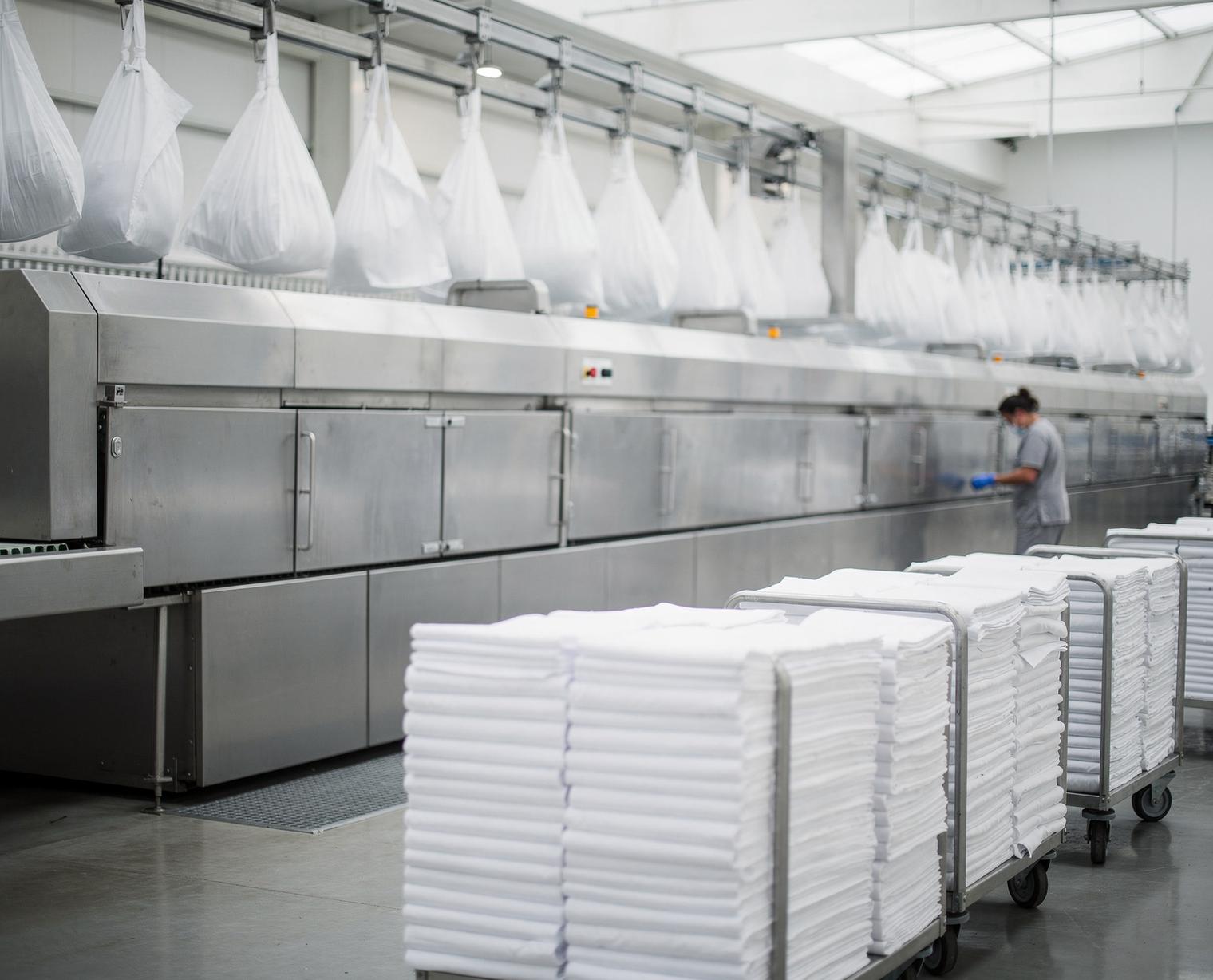
Table of contents
- What does commercial laundry mean?
- What are the four types of laundry service?
- What happens inside a commercial laundry facility
- Commercial laundry regulations and safety
- How commercial laundry management works
- Which model fits which business?
- Frequently asked questions
- Talk with a regional commercial laundry
Commercial laundry is the washing, finishing and delivery of textiles for businesses rather than households, usually done in a dedicated plant on a recurring schedule. A commercial laundering service collects soiled linens, towels, garments or uniforms from a hospital, restaurant, clinic or shop, processes them in bulk on industrial equipment, and returns them clean and ready to use. The term gets used loosely, though, and "commercial," "industrial," "on-premise" and "wash-and-fold" describe four different ways of getting the same job done. Each comes with its own costs, risks and regulatory burdens.
We have run a commercial laundry business since 1931, and this guide draws on what we see every day in our plants. It covers what each model is, who uses it, the rules that apply, and how a laundry program is managed once it is running.
What does commercial laundry mean?
Commercial laundry means laundry processed for a business, at volume, by a specialist operator. Three things separate it from doing laundry at home or at a laundromat:
- Scale. A commercial laundry facility measures output in pounds per hour, not loads per day. The tunnel washer at our Zanesville production facility processes more than 5,600 pounds of laundry an hour.
- A controlled, documented process. Wash time, temperature and chemistry are set for each textile and soil type, then monitored, so the result is repeatable.
- Logistics. Scheduled pickup and delivery, inventory counts and replacement of worn items are part of the service as well as the washing.
Off-site commercial laundries typically work under one of two arrangements. In a rental program, the laundry owns the textiles, and the customer pays to use them. In a customer-owned goods (COG) program, the customer buys and owns the linen and pays only for laundering. The CDC describes the same split for healthcare: off-site commercial laundries either process facility-owned textiles for a laundering fee or supply processor-owned textiles for a rental fee per piece. Our guide to how commercial linen rental works covers who buys, tracks and replaces inventory under each arrangement.
What are the four types of laundry service?
For a business, the four types of laundry service are commercial linen and uniform service, industrial laundry service, on-premise laundry, and retail wash-and-fold. The table summarizes how they differ.
| Model | Who does the washing | Who usually owns the textiles | Typical items | Typical users |
|---|---|---|---|---|
| Commercial linen and uniform service | An off-site plant with route delivery | The laundry (rental) or the customer (COG) | Sheets, gowns, scrubs, towels, napkins, tablecloths, aprons, uniforms | Hospitals, clinics, restaurants, caterers, hotels, spas, salons |
| Industrial laundry | An off-site plant set up for work soil | Varies by program | Work uniforms, shop towels, floor mats, mops | Manufacturers, auto shops, HVAC and construction firms |
| On-premise laundry (OPL) | The business's own staff, in its own building | The business | Whatever the facility uses | Hotels, nursing homes, some hospitals, gyms |
| Wash-and-fold / laundromat | A retail laundry, by the pound | The customer | Mixed small loads | Households, very small businesses |
Commercial linen and uniform service
A provider supplies, launders and delivers textiles on a fixed route schedule, with stock levels (called par levels) set to match how much each location uses. Healthcare and hospitality rely on this model because both need linen that is clean, consistent and on the shelf on time. The CDC estimates that US healthcare alone generates about 5 billion pounds of laundry a year.
Industrial laundry service
An industrial laundry processes work textiles from shops, plants and job sites: uniforms, shop towels, mats and mops, including towels soiled with oils or solvents. Regulators treat it as its own category. The EPA has reviewed industrial laundries separately for wastewater purposes and has a specific rule for solvent-contaminated wipes sent out for laundering (both covered below). The line between commercial and industrial is not rigid, and a company offering industrial laundry and linen supply may run both kinds of work. We run industrial uniform and shop towel programs alongside restaurant and medical linen.
One caution on wording: "industrial linen services" sometimes just means linen service at industrial scale. If you are comparing providers, ask what soil types and textile categories each plant is set up for.
On-premise laundry (OPL)
An on-premise laundry is a laundry room the business owns and staffs itself. It gives you direct control and same-day turnaround. In exchange, you take on equipment purchase or leasing, maintenance, utilities, chemicals, labor, floor space and compliance. Note that commercial laundry leasing, meaning leased washers and dryers for an OPL, is different from commercial laundry rental, where you rent the linens and the washing is included.
The costs of an OPL tend to be spread across several budgets, which makes them easy to undercount. We go through them in our article on moving from an OPL to a service, and our outsourcing overview covers what happens to existing equipment and linen inventory during a switch.
Wash-and-fold and laundromats
Retail wash-and-fold services wash commercial laundry for some small businesses by the pound, and for a few dozen towels a week that can be a reasonable fit. The limits show up as volume or hygiene requirements grow. Loads are generally not processed to a validated healthcare or food-service standard, there is no inventory management or replacement, and the business still buys and owns everything. Our commercial laundry service guide for restaurants and medical facilities compares the two side by side.
What happens inside a commercial laundry facility
Commercial laundry facilities differ in equipment, but the work follows the same sequence.
- Collection and transport. Soiled textiles are bagged at the customer site and loaded so they stay separate from clean goods on the truck.
- Soil sorting. Items are sorted by type and soil level. In healthcare plants, this happens in an area kept physically separate from the clean side.
- Washing. Batch tunnel washers or washer-extractors run formulas with set time, temperature and chemistry. A final "sour" rinse neutralizes alkalinity.
- Extraction and drying. A press or extractor removes most of the water before dryers finish the load. Our Zanesville line pairs a water-extraction press with seven dryers.
- Finishing. Flatwork is ironed and folded; garments are steamed or pressed. Stained or damaged pieces are pulled out.
- Inspection and packing. Clean goods are counted, wrapped or carted, and staged for the route.
- Delivery. The driver restocks to par and collects the next soiled load.
In our own plants, restaurant linen goes through a patented "check point" quality control system, and every product is ironed, steamed or folded before it leaves. Healthcare linen is processed separately under healthcare-specific standards. Our Zanesville plant has focused strictly on hospital linen since 1990.
Commercial laundry regulations and safety
Commercial laundry regulations come from several sources: worker-safety rules, infection-control guidance and environmental requirements, with voluntary certifications on top. They matter to you as a customer for two reasons. If you run an OPL, the obligations are yours. If you outsource, some of them still start in your building.
OSHA rules
- Bloodborne pathogens. Under 29 CFR 1910.1030, contaminated laundry must be bagged where it was used, without sorting or rinsing there, and moved in labeled or color-coded bags. Wet laundry that is likely to soak through or leak must go in containers that prevent leakage to the exterior, and employees who handle it must wear gloves and other appropriate protective equipment. This applies to the facility generating the laundry as well as the plant receiving it.
- Hazard communication. Wash chemicals fall under 29 CFR 1910.1200, which requires labeled containers, safety data sheets and employee training.
- Lockout/tagout. Washers, presses, ironers and conveyors must be isolated from their energy source before servicing, under 29 CFR 1910.147.
OSHA sets requirements but does not certify laundries. A provider can accurately say it follows OSHA-compliant procedures. "OSHA-certified" is not a real designation.
CDC guidance for healthcare textiles
The CDC's laundry and bedding guidance is the reference point for healthcare linen. Its main points:
- Soiled receiving areas should be kept at negative air pressure relative to clean areas, so lint and aerosols do not drift onto finished goods.
- For hot-water washing, at least 160°F for a minimum of 25 minutes is commonly recommended, and chlorine bleach adds a further margin of safety.
- The goal is "hygienically clean" linen, which carries negligible risk to patients and staff provided it is not recontaminated before use. That proviso is why handling, packaging and transport of clean linen matter as much as the wash itself.
Wastewater and solvent-soiled wipes
Industrial laundries discharge to municipal sewer systems. In 1999 the EPA decided against national pretreatment standards for industrial laundries. Beyond the general federal pretreatment prohibitions, limits are set by the local treatment authority, so a plant's discharge requirements depend on where it operates. Separately, a 2013 EPA rule lets reusable solvent-contaminated wipes go to a laundry without being managed as hazardous waste, as long as conditions are met, including that they contain no free liquids. Any business sending shop towels out for laundering needs to know that condition.
Voluntary certifications
No US government agency has set an acceptable bacterial level for laundered textiles, so third-party programs fill the gap.
- HLAC accreditation covers the healthcare laundry process from end to end: soiled handling and transport, in-plant processing, delivery, facility layout and staff training, verified by on-site inspection against the HLAC standards.
- TRSA Hygienically Clean adds ongoing laboratory testing: quarterly RODAC plate tests and semi-annual USP 62 screening. For healthcare, the total aerobic microbial count must be no more than 20 colony-forming units per square decimeter, and specified organisms must be absent.
- TRSA Clean Green sets water and energy use standards per pound alongside best management practices.
We hold all three, plus TRSA Hygienically Clean Food Service for restaurant linen. Details are on our certifications page. Our hospital laundry was among the first to earn HLAC accreditation, in 2007, and has kept it since. Whichever provider you consider, ask for current certificates that name the plant processing your linen, and for recent test results. Our healthcare laundry compliance guide lists the documents to request.
Commercial laundry safety in an on-premise laundry
If you keep laundry in-house, commercial laundry safety is your responsibility. The hazards the standards above address are chemical exposure, contaminated linen and machinery servicing. Dryer lint belongs on the list too. NFPA publishes fire data for home dryers only, and there failure to clean is the leading factor contributing to ignition. The same discipline applies to commercial dryers: clean lint traps and ducts on a schedule. An OPL needs written procedures, training records and a maintenance schedule in addition to the machines themselves.
How commercial laundry management works
Commercial laundry management means keeping the right amount of clean linen in the right place at the lowest total cost. Getting the washing right is one part of it. The other parts are these:
- Par levels. How much of each item a location needs on hand between deliveries. If par is set too low, you run out. If it is set too high, you pay for linen that sits unused.
- Usage tracking. Comparing what was delivered with what came back shows where there is loss, hoarding or overuse.
- Replacement. Textiles wear out. Someone has to pull stained or torn pieces and bring in new stock.
- Billing review. Invoices should tie back to the agreed items, quantities and service level.
In an OPL, a manager on your payroll does all of this. With a rental provider, it should be part of the service. We give healthcare clients proprietary software to track and manage their inventory and meet each month to review usage and adjust the program. The software tracks linen movement through the facility, so those reviews can adjust par levels and pick up hoarding, loss, or a product that would do the job more efficiently. Our proposals list item rates, service charges and replacement pricing as separate line items, and we give notice before anything changes. For how providers typically structure charges, see our linen rental cost guide.
Which model fits which business?
- Hospitals, surgery centers and clinics: A commercial healthcare laundry with third-party certification. The documentation and separation requirements are hard to meet in a small in-house laundry room. See our hospital linen and medical linen programs.
- Restaurants, bars and caterers: Commercial linen rental. Table linen has to be pressed and folded, which takes equipment, space and staff time that a kitchen needs for service.
- Hotels and long-term care: Either an OPL or outsourcing can work. The decision depends on volume, labor availability, the age of existing equipment and what else the floor space could be used for.
- Manufacturing, automotive and trades: An industrial laundry program for uniforms, shop towels and mats.
- Salons, spas and gyms: Wash-and-fold or a small OPL can work at low volume. Towel rental is worth pricing once volume outgrows what staff can wash between clients.
Frequently asked questions
What is commercial laundry service?
A commercial laundry service launders textiles for businesses in a dedicated plant, with scheduled pickup and delivery. Most also rent the linens and uniforms themselves and manage inventory and replacement.
What is the difference between commercial and industrial laundry?
Commercial laundry usually refers to linen and garments for healthcare, hospitality and food service. Industrial laundry refers to heavily soiled work textiles such as uniforms, shop towels, mats and mops. The same provider may offer both.
Is an on-premise laundry cheaper than outsourcing?
It depends on volume and on whether every cost is counted. Equipment, repairs, utilities, chemicals, labor, linen replacement and floor space all belong in the comparison with a service quote.
Can I rent linens instead of buying them?
Yes. Under commercial laundry rental, the provider owns the textiles, and you pay for the items you use, with laundering, delivery and replacement handled within the program.
Talk with a regional commercial laundry
We are a family-owned linen and uniform service with production plants in Dayton and Zanesville and distribution in Cincinnati, Columbus and Indianapolis. Our routes cover Ohio, Indiana and Northern Kentucky, with West Virginia communities confirmed case by case. Jodi Williams of St. Elizabeth Surgery Center describes the service this way: "The local service team has always been responsive and never failed to deliver our needs." If you are weighing an OPL against outsourcing, or comparing providers, contact us for a program review and a quote built around your actual usage.
Ready to get started?
Talk to our team and see how we can help.