PPE Supplies: What Each Workplace Needs and How to Source It
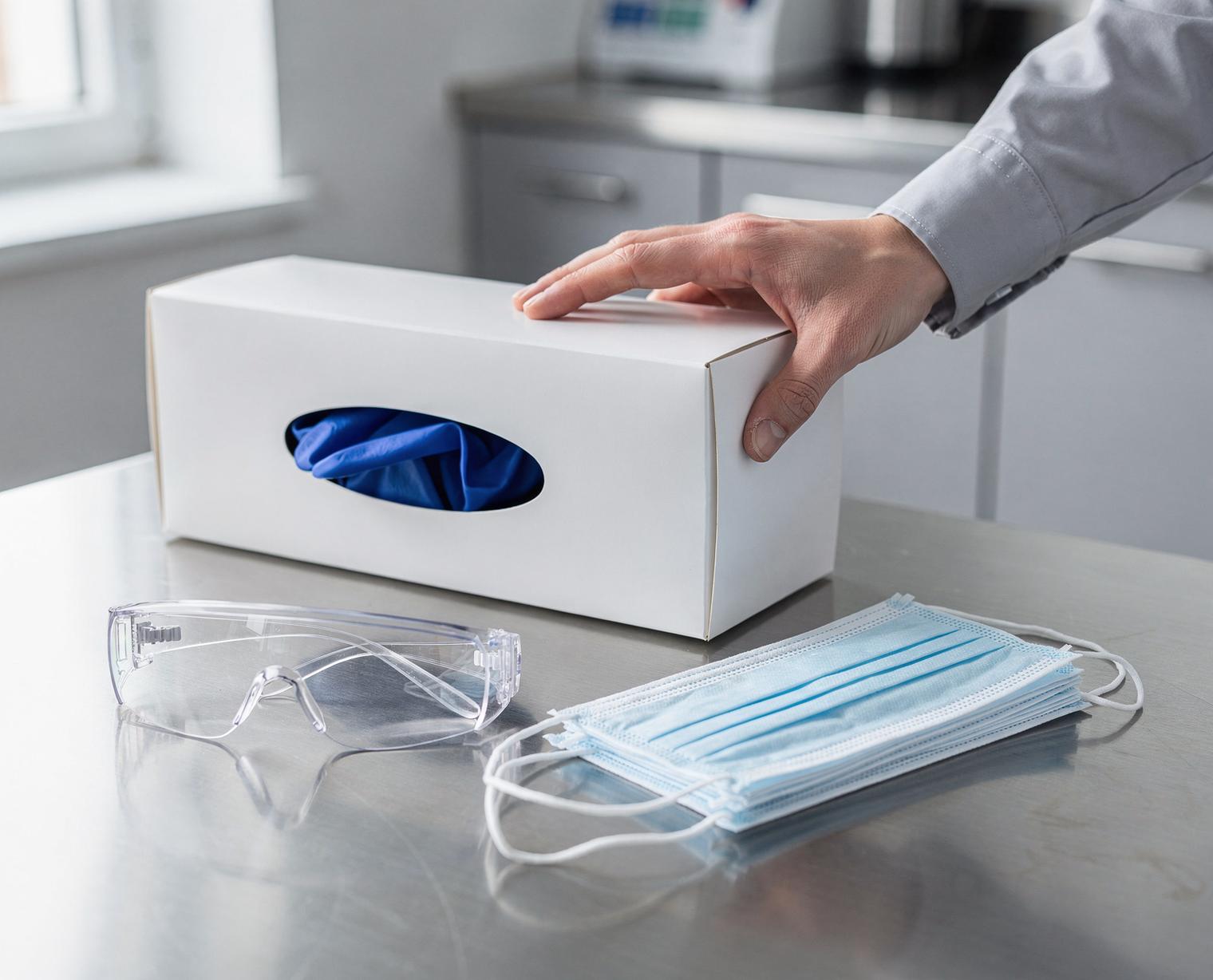
Table of contents
PPE supplies are the gloves, gowns, masks, eye protection and protective clothing that stand between a worker and a hazard on the job. Which items you need depends on that hazard: blood and body fluids in a clinic, knives and degreasers in a kitchen, chemical vapors in a salon. This guide lists what each workplace typically stocks, what the rules say about who pays, and how to source it all without adding another vendor and another delivery day.
What are PPE supplies?
PPE stands for personal protective equipment. OSHA's general standard, 29 CFR 1910.132, covers "personal protective equipment for eyes, face, head, and extremities, protective clothing, respiratory devices, and protective shields and barriers." In practice, a PPE supplies list for a small or mid-size workplace comes down to six categories:
- Hand protection: disposable exam and utility gloves, cut-resistant gloves, heat-resistant gloves.
- Body protection: isolation gowns, lab coats, aprons, coveralls.
- Face and respiratory protection: surgical masks, N95 respirators, face shields.
- Eye protection: safety glasses and splash goggles.
- Head protection: hard hats.
- Foot protection: safety-toe footwear.
One distinction saves a lot of confusion when you order. Some items people call PPE protect the product or the customer, not the worker. Food-handling gloves and hairnets are the usual examples. They are required by food safety rules, not by OSHA's PPE standard, and that changes which rule you are complying with when you buy them.
Who is required to supply PPE in the workplace?
The employer. Under 1910.132(h), protective equipment used to comply with OSHA standards "shall be provided by the employer at no cost to employees." The employer also has to assess the workplace for hazards, choose PPE that fits each affected employee, and keep a written certification that the assessment was done.
There are a few narrow exceptions to the payment rule:
- Non-specialty safety-toe footwear and non-specialty prescription safety eyewear that employees are allowed to wear off the job.
- Everyday clothing such as long pants, long-sleeve shirts and normal work boots.
- Ordinary weather gear such as winter coats and raincoats.
- Replacement of PPE the employee lost or intentionally damaged.
An employee may use PPE they already own if it is adequate, but the same rule says the employer "shall not require an employee to provide or pay for his or her own PPE."
Employers whose staff are exposed to blood, including healthcare and dental practices, also fall under a second rule. The Bloodborne Pathogens standard requires them to provide gloves, gowns, lab coats, face shields or masks and eye protection at no cost. It also makes the employer responsible for cleaning, laundering and disposing of that PPE. Staff should not be taking contaminated gowns or lab coats home to wash.
PPE supplies list by workplace
| Workplace | Main hazards | Typical PPE | Rule or guidance to check |
|---|---|---|---|
| Hospitals, surgery centers, clinics | Blood, body fluids, splashes, airborne infection | Exam gloves, isolation gowns, surgical masks, N95 respirators, goggles or face shields | OSHA 1910.1030; CDC Standard Precautions |
| Dental offices | Spatter and aerosols, sharps | Gloves, masks, protective eyewear, face shields, gowns or lab coats | OSHA 1910.1030; CDC dental guidance |
| Restaurants, bars, catering | Cuts, burns, cleaning chemicals; contamination of food | Cut-resistant gloves, heat protection, splash goggles for chemicals; food-handling gloves and hair restraints | OSHA 1910.132, .133, .138; FDA Food Code |
| Hair and nail salons | Chemical contact and vapors | Chemical-appropriate gloves, goggles, long sleeves, knee-length clothing | OSHA salon guidance; Hazard Communication |
| Industrial and trade sites | Flying particles, chemicals, cuts, abrasion, heat | Safety glasses, face shields, task-rated gloves, protective workwear, head protection | OSHA 1910.132 through .138 |
Hospitals and medical facilities
For anyone asking what counts as PPE in healthcare, the CDC's Standard Precautions give the working list. Gloves and a gown go on when contact with blood or body fluids is anticipated. A mask plus goggles or a face shield go on for anything likely to generate splashes or sprays. A fit-tested N95 or higher respirator is added for aerosol-generating procedures on patients with suspected or proven respiratory infections.
Two buying details matter more than the rest when you order hospital PPE supplies:
- Gown barrier level. Isolation gowns are rated under ANSI/AAMI PB70 on a scale of Level 1 to Level 4. Level 4 is the only level tested against bloodborne pathogen penetration. According to the FDA's gown guidance, a reusable gown has to be barrier-tested at the end of its labeled use-life, so ask any supplier for both the level and the rated number of laundering cycles.
- Mask versus respirator. A surgical mask is not fit-tested. An N95 is, and OSHA requires an initial fit test and annual tests after that. NIOSH notes that surgical mask filter efficiency can range from under 10% to nearly 90%, which is why the two are not interchangeable.
Gowns are the one PPE item you can rent instead of buy. We supply reusable isolation gowns that we launder and return on a set schedule, along with scrubs, lab coats and patient gowns. Using a laundry service is one way to meet the standard's requirement that the employer, not staff, launders this PPE. If you need a specific AAMI level, tell us at the start so we can confirm what fits your protocol. Our post on patient gowns versus isolation gowns covers how to plan the two inventories separately.
Dental offices
The CDC's dental guidance lists gloves, face masks, protective eyewear, face shields and protective clothing, which can be a reusable or disposable gown, jacket or lab coat. The CDC's PPE best practices say PPE should be changed between each patient at a minimum, masks changed sooner if they get wet, gloves never washed or reused, and protective clothing changed when soiled or penetrated.
For a practice manager, that translates into steady, predictable volume: gloves and masks per patient, and enough lab coats or gowns per clinician to change mid-day. We rent and launder lab coats and scrubs on a set schedule, which handles the clothing side.
Restaurants, bars and catering
Restaurant PPE supplies come as two shopping lists, because two different sets of rules apply.
To protect workers (OSHA): cut-resistant gloves for slicers and knife work, heat protection for ovens and fryers, and splash goggles for anyone handling concentrated degreasers or sanitizer. OSHA's hand protection standard names severe cuts, chemical burns and thermal burns specifically, and the employer pays.
To protect food (FDA Food Code): the Food Code bars bare-hand contact with ready-to-eat food and allows single-use gloves, tongs, deli tissue or other utensils instead. It also requires hair restraints such as hats, hairnets and beard restraints for staff working around exposed food. Check which version of the code your health department follows.
Aprons and chef coats sit in between. They are not rated PPE, but they keep spills off street clothes and are the first thing to come off after a splash. We rent and launder bib aprons and chef coats, and stock food-service gloves, E2 food-service hand soap and sanitizer for the same kitchens.
Hair and nail salons
PPE supplies for salons are mostly about chemicals. OSHA's nail salon guidance tells workers to wear goggles and the right type of disposable gloves when handling and transferring products. Glove material matters here: nitrile protects against many salon chemicals, but OSHA points to latex or vinyl for acetone. Long sleeves and knee-length clothing protect arms and laps from dust and drips.
The common mistake is the mask. OSHA says plainly: "Do not use surgical masks." They do not protect against gases, vapors or fine particulates. Where exposure calls for respiratory protection, it has to be a respirator with training and fit testing. Hair salons using formaldehyde-containing hair products have a related problem. OSHA has measured formaldehyde above the short-term exposure limit in salons and requires air testing, ventilation and appropriate PPE where those products are used.
For the textile side, our salon program covers towels, hand towels and aprons on a regular schedule.
Industrial, workwear and office PPE
Industrial sites buy the widest range: safety glasses and face shields under OSHA's eye and face protection standard (look for the ANSI Z87.1 marking), task-rated gloves and hard hats. The hazard assessment drives the list, so start there before you request quotes.
We rent industrial work shirts, pants and trade uniforms and supply shop towels and disposable gloves in nitrile, neoprene and vinyl. Standard work uniforms are not rated protective garments. If part of your crew needs flame-resistant or arc-rated clothing, raise it in the first conversation so nobody assumes a regular uniform covers it.
Offices need the least: disposable gloves and eye protection for whoever handles cleaning chemicals, plus hand sanitizer, soap and disinfectant, which are hygiene supplies and not PPE in the strict sense.
Who supplies PPE, and where to buy it
Four kinds of companies sell PPE to businesses. Each suits a different order.
| Source | Best for | Trade-off |
|---|---|---|
| Medical-surgical distributors | Respirators, sterile and procedure-specific items | A separate account, invoice and delivery |
| Industrial safety distributors | Rated eyewear, hard hats, specialty gloves | Another vendor, another invoice, separate freight |
| Online marketplaces and big-box stores | One-off or emergency purchases | You verify ratings and authenticity yourself; someone has to remember to reorder |
| Linen and uniform services with a supply division | Recurring consumables plus reusable gowns, coats and aprons | Narrower range of specialty safety gear |
A PPE store near you solves today's shortage. A standing order on a weekly route prevents the next one.
Buying bulk or wholesale without overpaying
- Split reusable from disposable. Gowns, lab coats and aprons can be rented and laundered. Gloves, masks and wipes are bought by the case. Pricing them together hides where the money goes.
- Order to usage, not to a discount tier. Bulk PPE supplies only save money if you use them before they age out. Check the stated shelf life on anything you plan to stockpile.
- Compare per-unit cost at the right spec. Cheap PPE supplies that tear or fail a fit test get doubled up or thrown out. Compare gloves at the same material and thickness, and gowns at the same AAMI level.
- Ask for line-item pricing. You should see a price for each product and any delivery charge stated separately, so a quote can be compared against your current invoices.
- Verify ratings on the item. Look for NIOSH approval on respirators, the Z87 marking on eyewear and a stated AAMI level on gowns.
Getting PPE delivered with your linen service
Premier Janitorial is our supply division, with more than 2,000 items available to order online. For customers already on a route, supplies ride on the same weekly truck as linens, uniforms and floor mats. As our delivery guide puts it, if a truck is stopping for linens or mats, the cases come with it.
What that covers in practice:
- Disposable gloves: latex, vinyl, synthetic, nitrile and neoprene, in powdered and powder-free options, for healthcare, food service and industrial use. That page has the detail on choosing a material.
- Reusable isolation gowns, lab coats, scrubs and aprons: rented, laundered and exchanged on schedule.
- Hand soaps and sanitizers: antibacterial, E2 food-service and industrial soaps, instant sanitizer and hands-free dispensers.
- Wipers and disinfectants: medical, food-service and industrial wipers, quaternary cleaners and disinfectant sprays.
- Can liners and paper products: including infectious-waste and bio-hazard liners for healthcare.
Our product pages do not list every catalog item. If you need masks, eye protection or another specific item, ask and we will tell you whether we carry it. Specialty gear such as fit-tested respirators may be better sourced from a safety distributor, and we would sooner say so than sell you the wrong thing.
On healthcare textiles, our processing is independently checked. Our hospital laundry operation has been HLAC-accredited since 2007, and both production plants hold TRSA Hygienically Clean Healthcare certification, with quarterly testing by an independent accredited laboratory. Those certifications cover the gowns, coats and linens we launder. They do not cover disposable products, which carry their manufacturers' ratings.
We run routes from Dayton, Zanesville, Cincinnati, Columbus and Indianapolis, covering much of Ohio and Indiana, Northern Kentucky and parts of West Virginia. To price a program, send us your address and the products you reorder most, or call 1-800-536-1000. You get line-item pricing and your route delivery day. Our guide to bundling linens, uniforms and supplies with one vendor covers when that makes sense and when it does not.
Frequently asked questions
What are some examples of PPE in healthcare?
Exam gloves, isolation gowns, lab coats, surgical masks, N95 respirators, goggles and face shields. CDC Standard Precautions tie each one to the exposure: gloves and gowns for contact with blood or body fluids, masks and eye protection for splashes and sprays, and fit-tested respirators for aerosol-generating procedures.
What companies sell PPE?
Medical-surgical distributors, industrial safety distributors, online marketplaces and big-box stores, and linen and uniform services with a supply division. A linen and supply provider can cover recurring items such as gloves, gowns, soap and wipes, with a safety distributor for specialty gear.
Who is required to supply PPE in the workplace?
The employer. OSHA requires employers to provide PPE needed to comply with its standards at no cost to employees, with narrow exceptions such as non-specialty safety-toe footwear, everyday clothing and ordinary weather gear. Where workers have occupational exposure to blood, the employer must also clean, launder or dispose of that PPE at no cost to them.
Are food service gloves and hairnets considered PPE?
Not in the OSHA sense. They protect the food, not the worker, and are required by food safety rules based on the FDA Food Code. Cut-resistant gloves, heat protection and chemical splash goggles are the worker-protection PPE in a kitchen.
Who can supply PPE, paper products, gloves and soaps along with linen service?
A linen service with its own supply division can. We deliver gloves, soaps, sanitizers, wipers, paper products and can liners through Premier Janitorial on the same weekly routes as linens, uniforms and mats across Ohio, Indiana, Northern Kentucky and parts of West Virginia.
Is it better to rent or buy isolation gowns?
It depends on your volume and protocol. Renting reusable gowns removes the laundering burden and keeps a steady supply on hand. Either way, confirm the AAMI barrier level your procedures require before you compare prices.
Ready to get started?
Talk to our team and see how we can help.