Surgical Linen Guide: Huck Towels, Drapes, Wraps and OR Attire
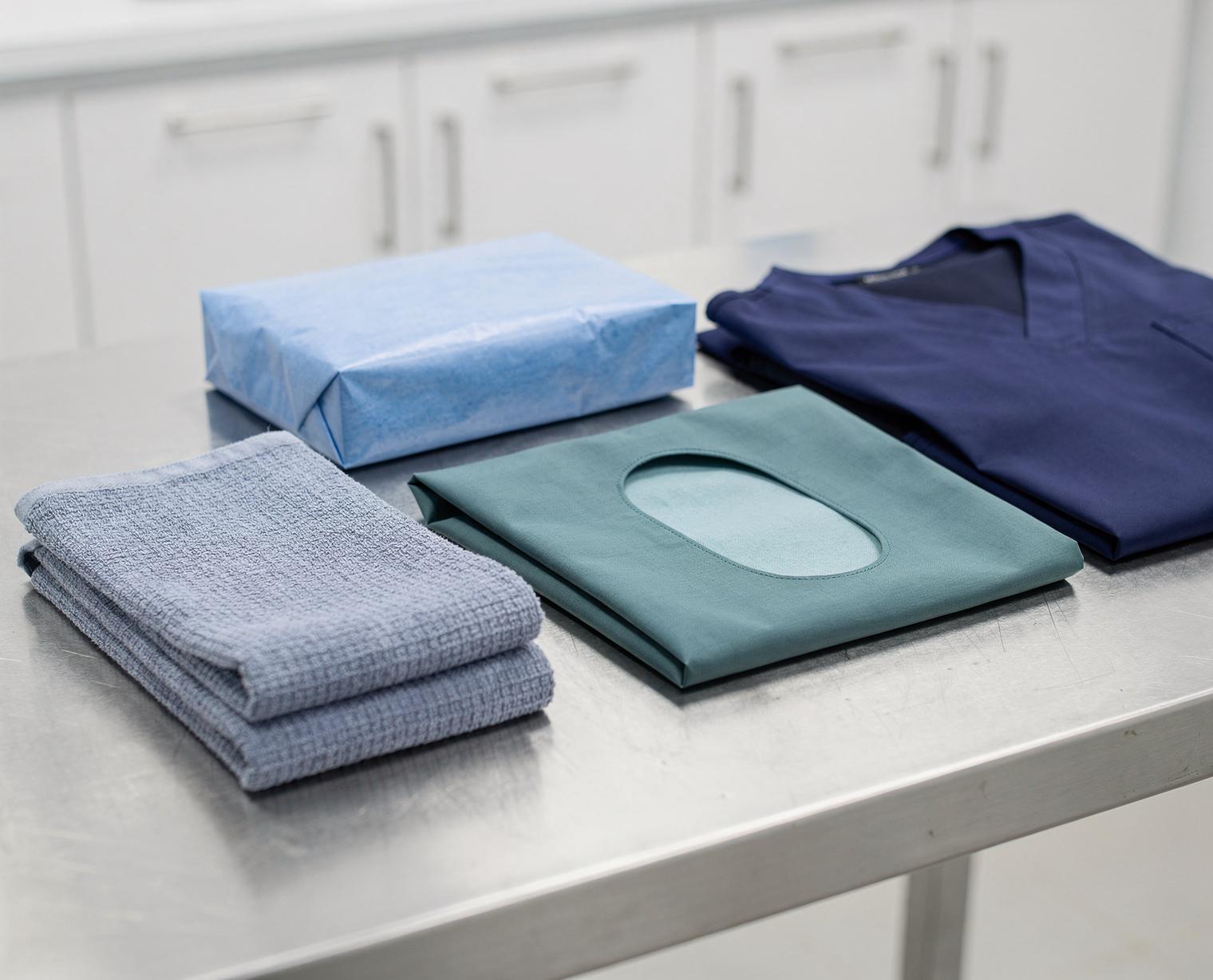
Table of contents
- Surgical linen at a glance
- Huck surgical towels: what they are and how the OR uses them
- What are surgical drapes made of?
- Sterilization wraps
- What are the surgery clothes called?
- Reusable vs. disposable surgical textiles
- How OR linen is laundered and inspected
- Renting vs. buying surgical towels and linen
- What to look for in a surgical towel service for a surgery center
- Frequently asked questions
Surgical linen is the group of textiles that touch a procedure from scrub sink to closing count: huck surgical towels, drapes, sterilization wraps, and the attire the team wears. Each one has its own fabric, its own standard, and its own failure mode (lint, holes, strike-through, lost barrier). This guide explains what each item is, what it is made of, how reusable versions are laundered and inspected, and how to decide between renting, buying, and going disposable.
We have been in the linen business since 1931, and by 1990 our Zanesville, Ohio, plant had focused strictly on hospital linen. We have written this from the laundry side of the dock: what goes wrong with OR textiles, and what a surgery center should ask before it signs anything.
Surgical linen at a glance
| Item | What it does | Typical reusable material | Typical disposable material | Sterile at point of use? |
|---|---|---|---|---|
| Huck (OR) towel | Hand drying after the scrub, squaring off the incision site, covering instruments, absorbing fluid | 100% cotton huckaback weave | Cotton, sold pre-sterilized for single use | Yes, when used in the sterile field |
| Surgical drape | Isolates the incision site and creates the sterile field | Woven polyester, with a laminated barrier in critical zones | SMS polypropylene, spunlace, or fabric laminated to plastic film | Yes |
| Sterilization wrap | Encloses instrument trays and packs through sterilization and storage | Woven cotton-polyester blend | SMS polypropylene | Wrap contents are sterile; the wrap is the barrier |
| Surgical gown | Sterile barrier worn by scrubbed staff | Woven polyester with reinforced, laminated critical zones | SMS polypropylene | Yes |
| Scrubs, jackets, caps | Clean base attire for semi-restricted and restricted areas | Low-lint woven fabric | Disposable caps and some disposable apparel | No. Clean, not sterile |
Huck surgical towels: what they are and how the OR uses them
"Huck" is short for huckaback, a flat weave built on a plain-weave base in which selected yarns float over several threads to form a small, pebbled, bird's-eye texture. There are no terry loops. That makes a huck towel lighter and lower in bulk than terry, and the tight weave keeps lint low.
The practical specifications are consistent across manufacturers:
- Fiber: 100% cotton, pre-washed so it absorbs from the first use.
- Size: roughly 16 by 26 inches. The CDC's own steam sterilizer test pack is defined as 16 reusable huck or absorbent surgical towels of approximately 16 inches by 26 inches. You will also see 15 x 26 and 17 x 26.
- Color: blue or green for the OR.
In the room, the same towel does three jobs. Scrubbed staff dry their hands and arms with one before gowning. Four towels folded and placed around the incision site form the "quarter drape" that squares off the surgical window before the main drape goes on. And towels cover instruments.
One caution. Anything that could be left in a patient is a counted item. AORN's evidence on retained surgical items states that radiopaque sponges and soft goods should be used in sterile and delivery fields, and X-ray detectable OR towels are available. Whether a plain towel can go near an open wound is a question for your count policy, not for your linen supplier.
Why is a surgical towel green or blue?
Operating rooms were once all white. When bright electric lights replaced daylight, white linen produced glare, and surgeons looking up from a red operative field onto a white background saw green afterimages. In 1914, surgeon Harry Sherman recommended green because it was "less wearisome to the eyes" and kept the surgeon's eye "acute to red and pink." Operating theaters moved to green and bluish-green walls, gowns, drapes, towels, and sheets, as a history of color in the operating theatre records. A green surgical towel or blue drape does the same job today: less glare, less eye fatigue, and blood and tissue that stay visually distinct.
What are surgical drapes made of?
Surgical drapes are made of either a reusable woven fabric, almost always polyester today, or a disposable nonwoven, usually polypropylene, sometimes bonded to plastic film. The material has changed a great deal, and the older ones explain why modern specifications look the way they do.
Reusable drape fabrics
- Muslin (historical). The CDC defines muslin as a loosely woven, 140-thread-count, 100% cotton cloth formerly used for drapes and pack wraps. It absorbs fluid rather than resisting it, and it sheds lint.
- Tightly woven barrier cotton and blends. Cotton or polyester-cotton fabrics of 175 to 280 thread count were an early water-repellent reusable barrier. Their resistance to liquid diminished with repeated washing.
- Woven polyester. Continuous-filament polyester, often with carbon fibers woven in to dissipate static, releases very few particles and resists tearing and abrasion.
- Laminates. In the critical zone around the incision, modern reusable drapes sandwich a breathable, liquid-proof membrane (expanded PTFE or polyurethane) between two layers of knit polyester.
Disposable drape materials
- SMS polypropylene. Spunbond-meltblown-spunbond: two strong outer layers around a fine-fibered middle layer that provides repellency.
- Spunlace. Wood pulp and polyester fibers entangled with water jets. Soft and absorbent.
- Film laminates. An absorbent nonwoven bonded to polyethylene film to stop strike-through. Adhesive incise drapes are polyurethane or polyethylene film.
Barrier levels: the number that matters more than the fabric
The FDA regulates surgical drapes and surgical gowns as Class II medical devices. Both are rated for liquid barrier performance under ANSI/AAMI PB70:
| PB70 level | Test | What it means |
|---|---|---|
| Level 1 | Water impact penetration (AATCC 42), 4.5 g or less | Minimal: some resistance to water spray |
| Level 2 | AATCC 42 at 1.0 g or less, plus hydrostatic pressure (AATCC 127) of at least 20 cm | Low: resists spray and some penetration under pressure |
| Level 3 | AATCC 42 at 1.0 g or less, plus AATCC 127 of at least 50 cm | Moderate |
| Level 4 | Viral penetration (ASTM F1671), pass | Highest: the only level tested against viral penetration |
The CDC's summary of the standard adds a point that is easy to miss: Levels 1 through 3 are water tests only, and no correlation can be drawn between those results and viral penetration. The FDA expects a reusable gown to be tested at the end of its labeled use life, not just when new, which is why counting uses matters (more on that below).
Sterilization wraps
A sterilization wrap is the sheet that encloses an instrument tray or linen pack, lets steam in during the cycle, and then keeps microbes out until the pack is opened. The FDA classifies it as a Class II device in its own right.
There are two families. Reusable wraps are woven, today a cotton-polyester blend rather than the old muslin. Disposable wraps are nonwoven SMS polypropylene. When a tray is double wrapped, the CDC's sterilization guidance describes two methods:
- Sequential wrapping: two sheets applied one after the other, creating a package within a package.
- Simultaneous wrapping: two sheets handled as one, which saves time. Use only wrap validated for this method.
A reusable woven wrap has to be checked over a light table for holes when it is processed, and any hole is covered with a heat-sealed patch. The CDC also asks that wrapping avoid tenting and gapping, and that written, illustrated wrapping procedures be available to the people doing it.
What are the surgery clothes called?
The clothes worn in surgery are collectively called surgical attire. The individual pieces have specific names, and the distinction between clean and sterile is the part people most often get wrong.
- Scrubs (scrub apparel). AORN defines scrub apparel as a scrub top, scrub pants, or scrub dress, with or without a long-sleeve scrub jacket. Scrubs are clean, not sterile.
- Scrub jacket, warm-up jacket, or cover jacket. Three names for the long-sleeved jacket worn over the scrub top.
- Head coverings. Bouffant caps and skull caps, disposable or cloth. AORN leaves the choice to the facility but expects a defined laundering method and frequency for reusable caps.
- Surgical gown. The sterile, PB70-rated gown that scrubbed team members put on over their scrubs after the hand scrub. This is the only item on the list that is part of the sterile field.
- Isolation or cover gown. Not surgical attire. It protects staff from splashes outside the sterile field. We explain the difference in patient gowns vs. isolation gowns.
On laundering, AORN's guidance is that scrub apparel should be laundered at a healthcare-accredited laundry facility, and that attire contaminated with blood or body fluids stays at the facility for laundering. The CDC is less absolute. It notes that experts are divided on taking work clothing home, says home laundering should adequately clean scrubs that carry no blood or body-fluid contamination, and says facilities that require uniforms should either launder them or give staff cleaning guidance. Garments contaminated with blood or other potentially infectious material must be laundered by the employer. In a surgery center, where that contamination is a routine possibility, facility-provided and professionally laundered scrub sets give you one policy instead of two. We cover the practical side in our article on switching to rental scrubs.
Reusable vs. disposable surgical textiles
Three things separate the two: environmental footprint, cost, and how much process control each one asks of you.
Environment. This is the clearest part of the evidence. A life-cycle study in the AORN Journal compared 1,000 uses of reusable surgical gowns (about 17 gowns, each processed 60 times) with 1,000 disposable gowns:
| Per 1,000 gown uses | Reusable | Disposable | Reduction with reusable |
|---|---|---|---|
| Natural resource energy | 9,396 MJ | 26,289 MJ | 64% |
| Greenhouse gas emissions | 557 kg CO2e | 1,636 kg CO2e | 66% |
| Blue water | 185 kg | 1,097 kg | 83% |
| Solid waste | 35.5 to 43.4 kg | 265 kg | 84% to 87% |
A 2012 peer-reviewed review by Overcash covering gowns and drapes across several life-cycle studies reached the same direction of result.
Cost. The evidence here is thinner, and we would rather say so than quote a flattering number. The same review describes modern reusable and disposable perioperative textiles as competitively priced, and we know of no detailed multi-hospital US cost study that settles it. Your result depends on case mix, pack design, waste hauling rates, and how many items you lose. The rent-versus-buy section below gives you the variables to run your own comparison.
Process control. Disposables arrive sterile and leave as waste. Reusables need a laundry that can wash, inspect, and track them, and then a sterilization step. A hybrid is also an option: disposable drape packs alongside reusable towels, scrubs, and general linen.
How OR linen is laundered and inspected
The governing document is ANSI/AAMI ST65, the standard for processing reusable surgical textiles, whether on site or off. Laundry accreditation and certification programs build on it. In sequence:
- Containment and soil sort. Soiled goods are bagged at the point of use and stay closed until they reach a soil-sort area that is physically separated from the clean side and held at negative air pressure, as the CDC recommends, so lint and aerosols do not travel toward clean linen.
- Washing. For hot-water cycles the CDC's benchmark is detergent in water of at least 160°F (71°C) for at least 25 minutes; validated lower-temperature chemical processes are also recognized. Each textile classification gets its own formula, and time, temperature, and chemistry are monitored on every cycle.
- Inspection for holes. Barrier textiles and wraps are inspected over a light table, where a pinhole shows as a point of light. HLAC's accreditation standards require inspection for cuts, tears, holes, loose threads, and residues, with repairs made before reuse. In critical zones the repair is a heat-sealed patch, never a stitch (needle holes are holes), and the item is rewashed after patching.
- Lint control. Lint in a surgical wound is a foreign body. Control starts with low-lint fabric choice (older muslin and blended sheeting abraded and shed lint far more readily than filament polyester) and ends with retiring textiles that have worn thin.
- Use tracking. A reusable barrier product is only rated for its labeled number of processing cycles. The Association of Surgical Technologists' drape standard puts that at about 75 reprocessings, and ST65 covers tracking each use. Some systems use RFID tags to do it.
- Clean-side handling. Finished linen is folded, wrapped or covered, and kept covered through loading, transport, and unloading.
Hygienically clean is not sterile
This is the single most important distinction in surgical linen. A healthcare laundry delivers textiles that are hygienically clean: in the CDC's words, free of vegetative pathogens but not sterile. The CDC is explicit that items such as surgical drapes and reusable gowns must be sterilized after laundering before use. So any towel, drape, or gown entering the sterile field has to be packed and steam sterilized, either in your sterile processing department or by a supplier that provides sterile packs. Ask every vendor which side of that line their delivery sits on.
"Hygienically clean" is also measurable. The TRSA Hygienically Clean Healthcare standard sets pass limits of 20 colony-forming units per square decimeter or fewer for total aerobic microbes, the same for yeast and mold, and specified pathogens absent.
Renting vs. buying surgical towels and linen
Buying looks cheap because the invoice shows only the purchase price. A towel bought outright still has to be washed, inspected, replaced, and counted by someone. To compare fairly, work out cost per use on both sides.
| Cost element | If you buy | If you rent |
|---|---|---|
| Initial inventory | You fund it. Plan for several sets per item: in use, in the soiled stream, clean on the shelf, and a safety margin | Supplied by the service |
| Laundering | On-site labor, utilities, chemistry, and equipment, or a separate laundry contract | Included in the per-piece or per-pound rate |
| Inspection and repair | Your staff, your light table, your documentation | Done at the plant |
| Replacement | You rebuy as items wear out or disappear | Wear is the service's cost; loss charges should be written into the agreement |
| Compliance evidence | You produce it at survey | You request the laundry's accreditation and test reports |
| Volume swings | Overstock or shortage when case volume changes | Par levels adjust |
A quick formula for the owned side: (purchase price ÷ expected uses) + laundering cost per use + (annual loss and replacement ÷ annual uses) + staff time per use. Compare that with the delivered rental rate plus any disclosed fees. The purchase price is only one of four terms, and not always the largest. Small items such as towels are easy to lose, so give the loss term an honest number.
Buying can make sense if you already run an accredited on-site laundry, or for specialty items no service stocks. For everything else, renting converts a capital purchase and a staffing problem into a predictable operating line. We go through the same logic for bed linen in our guide to buying vs. renting hospital sheets.
What to look for in a surgical towel service for a surgery center
The best outsourced linen service for a surgery center is the one that can document its process and is close enough to fix a shortage before your first case. Check these seven things, and ask for evidence rather than assurances. (For how this plays out in practice, see why Tristate surgery centers work with us.)
- Healthcare-specific accreditation. HLAC accreditation or TRSA Hygienically Clean Healthcare certification, for the plant that will actually process your goods.
- Recent microbial test results. Independent laboratory results, available on request.
- A clear answer on sterility. Does the vendor deliver hygienically clean bulk linen for you to sterilize, or sterile packs? Both are valid; ambiguity is not.
- Inspection and replacement practice. How are stained, thin, or torn items removed, and who pays?
- Usage data. Item-level delivery and usage reporting, and someone who reviews it with you.
- Written charges. Fuel, energy, loss, replacement, minimums, and renewal terms on paper before you sign.
- Local recovery. A branch that can cover a shortage between scheduled deliveries.
How we measure up, and where our limits are
We supply surgical towels, scrub sets, and operating room linens, along with patient gowns, isolation gowns, sheets, and bath linen, to hospitals and surgical facilities across Ohio, Indiana, and Northern Kentucky.
- Accreditation: our hospital services operation has been HLAC accredited since 2007, and both production plants hold TRSA Hygienically Clean Healthcare and Clean Green certifications.
- Testing: hospital linen is tested quarterly by an independent accredited laboratory using RODAC contact plates, with USP 62 pathogen screening twice a year. You can ask for the recent results from the plant that processes your linen.
- Inspection: each item is inspected by hand for stains, tears, and wear before delivery, and damaged or aging linen is pulled and replaced.
- Data: our proprietary inventory software records deliveries and usage by item, and we meet with customers monthly to adjust par levels before a shortage or overstock develops.
- Billing: terms for fuel, energy, loss and replacement, minimums, and renewal are written down, not discovered later.
The limit to be clear about: what we deliver is hygienically clean, not sterile. Items bound for the sterile field are sterilized by your sterile processing department before use. Tell us which items you want to source as reusables and we will tell you plainly which ones we can supply on your route.
Frequently asked questions
What is the difference between a huck towel and an OR towel?
In everyday use, none. "Huck towel" names the weave (huckaback), and "OR towel" or "surgical towel" names the job. An OR towel is a blue or green, 100% cotton huck towel of about 16 by 26 inches. Some OR towels add an X-ray detectable marker.
Are huck towels lint free?
No woven cotton textile is completely lint free. Huck towels are low lint because the weave is flat, with no terry loops to shed. Inspect them like any other OR textile and retire towels that have worn thin.
Can surgical towels be reused?
Reusable huck towels are designed to be laundered and re-sterilized many times. Towels sold sterile and labeled single use are not intended for reprocessing as surgical towels. Follow the manufacturer's labeling for the specific product.
Does a linen service deliver sterile surgical towels?
It depends on the service. A healthcare laundry delivers hygienically clean linen, which your sterile processing department then packs and sterilizes. Some suppliers also sell pre-sterilized packs. We deliver hygienically clean linen.
How many times can a reusable surgical drape or gown be used?
Only as many times as its manufacturer has validated, commonly 50 to 75 processing cycles. Each use should be tracked so the item is retired before its barrier rating expires.
If you run a surgery center or hospital OR in our service area and want a par-level estimate and written pricing for surgical towels, scrubs, and OR linen, request a quote and we will build it from your case volume.
Ready to get started?
Talk to our team and see how we can help.