Restaurant Table Linen Rental Guide: Tablecloths, Napkins and Runners
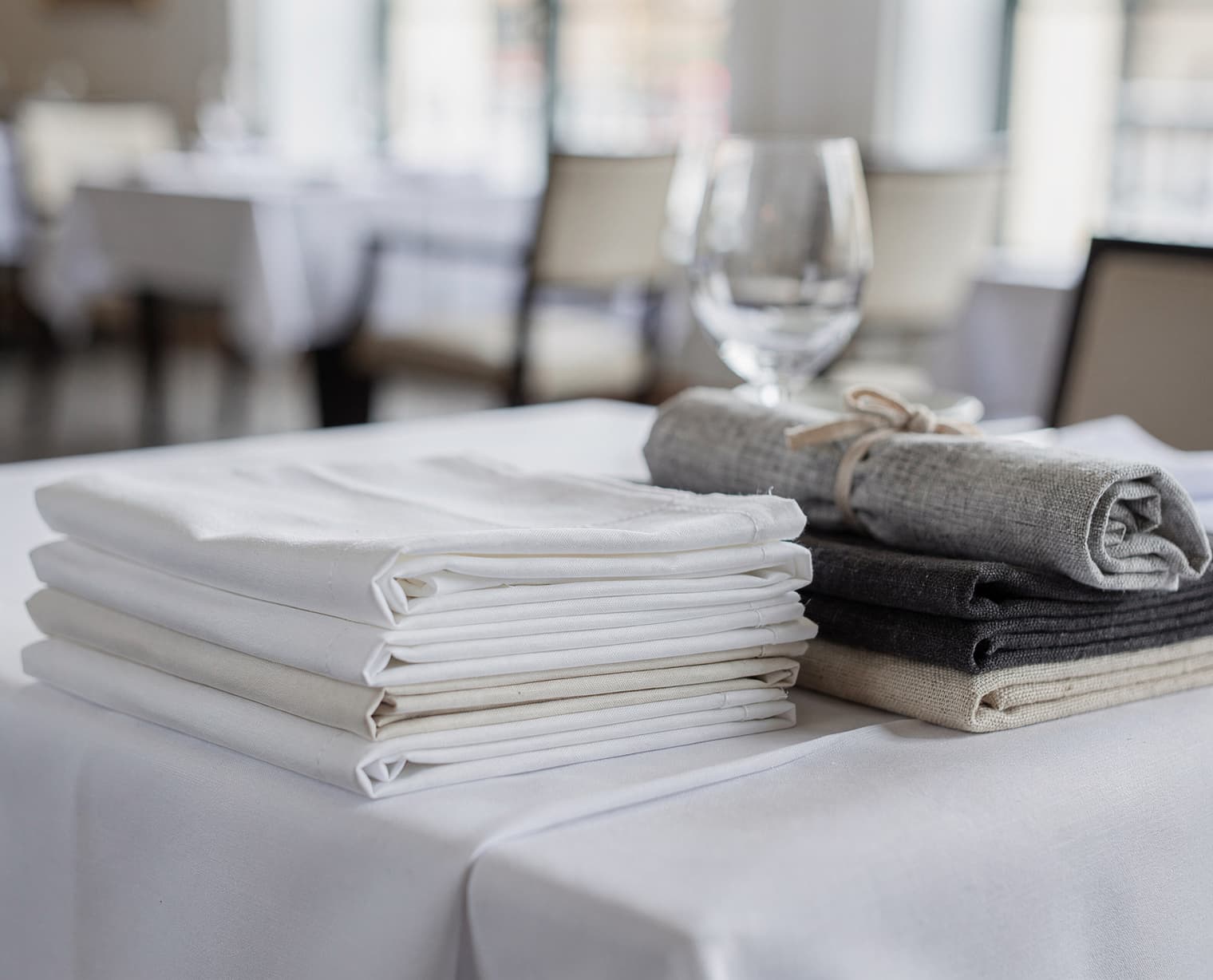
Table of contents
- What types of linen are commonly used in restaurants?
- Tablecloth and napkin fabrics: what you are actually choosing between
- Colours, patterns and finishes
- Weekly table linen service vs. one-off event rental
- Pressing, stain and hygiene standards: what to hold a provider to
- Getting the size right
- How to choose a table linen company
- Frequently asked questions
Renting table linen means one of two things, which is why a search for "rent table linen near me" turns up both party-rental companies and route-based linen services. The first is a per-event rental: tablecloths and napkins for a Saturday wedding, priced per piece and returned on Monday. The second, and the one restaurants, hotels and caterers with regular covers need, is a weekly service: a set stock of tablecloths and napkins that is picked up soiled, laundered, pressed and brought back on a route truck, week after week. This guide covers both, along with the fabrics, colours, finishes and quality standards that decide whether the linen on your tables helps or hurts the room. We have been renting and laundering restaurant linen out of Dayton, Ohio since 1931, so where our own practice is relevant we say how we do it.
What types of linen are commonly used in restaurants?
"Restaurant linen" covers everything textile that touches the table, the kitchen or the staff. The table-top pieces are the ones guests see:
| Item | What it does | Common sizes (industry convention) |
|---|---|---|
| Tablecloth | Covers the table top, defines the look of the room, protects the surface | Squares (52" to 72"), rectangles (54" × 72" up to 54" × 120" banquet), rounds (90" to 132"); drop of 8" to 12" for dining, longer for banquets |
| Table overlay / topper | Smaller square laid diagonally over a base cloth to add a second colour, or over a bare table in casual rooms | Usually 45" to 54" square |
| Dinner napkin | Lap and hand use; also the main "fold" element of a place setting | 20" × 20" is the restaurant standard; 22" in fine dining |
| Cocktail / beverage napkin | Bar service, passed hors d'oeuvres | Roughly 10" square |
| Table runner | Narrow strip down the centre or across the width; colour accent without a full cloth | 13" to 14" wide, length to suit the table |
| Table skirting | Hides table legs on buffets, head tables and registration tables | Sold by the linear foot, clipped to the table edge |
| Chair covers and sashes | Event dressing for folding or banquet chairs | Event rental, rarely in weekly programs |
Our weekly program is built around tablecloths and napkins; ask us about runners, overlays, skirting and chair covers before you plan an event around them, since not every route service stocks them. Behind the table are the working textiles that any restaurant linen service should supply in the same delivery: bar towels, kitchen towels, grill pads, low-lint glass towels for polishing, bib and bistro aprons, and chef coats. We cover those on our restaurant towels and restaurant uniforms pages; the rest of this guide stays on the table top.
Tablecloth and napkin fabrics: what you are actually choosing between
Rental pools are built mainly on polyester, and that is not a compromise: it stands up to repeated hot washing, holds its colour, dries quickly and looks pressed without starch. The question is which polyester, and whether you want cotton for specific jobs.
| Fabric | Hand and look | Strengths | Watch-outs | Best for |
|---|---|---|---|---|
| Spun polyester | Matte, cotton-like, soft | Durable, colourfast, holds a napkin fold, absorbs reasonably well | Can pill with age; absorbs oil-based stains more than filament | The usual choice for restaurants and banquets |
| Filament (sometimes sold as "visa") polyester | Smooth, slight sheen | Excellent stain release, very low lint, launders brilliantly | Less absorbent; can look shiny under warm light; folds do not stand as crisply | Hotels and event venues where stain release and sheen matter |
| 100% cotton | Soft, absorbent, natural drape | Most absorbent, feels premium, no sheen | Wrinkles, shrinks, wears faster, stains set harder; costs more per use | Fine dining napkins; we offer a 100% cotton napkin in white only |
| Poly-cotton blend | Between the two | Softer than pure polyester, more stable than pure cotton | Less common in rental pools; colour range narrower | Operators who want cotton feel with fewer wrinkles |
| Flax linen | Textured, slubbed, elegant | The original "table linen" | Wrinkles immediately, expensive, seldom offered for rental | Owned, not rented, by a handful of fine-dining rooms |
Two practical notes. Spun polyester is the fabric for standing folds; our Signature Series napkins are chosen for resilience and for holding a fold, and our guide to setting a restaurant table covers the folds themselves. Cotton shows every stain a laundry could not lift, which is why we offer our 100% cotton napkin in white only: white cotton can be bleached and rewashed, coloured cotton cannot.
Colours, patterns and finishes
White suits every room, photographs well and tolerates the harshest wash, and a white cloth with a coloured napkin is the simplest way to change the look of a dining room for a season or an event. Beyond white, our tablecloths come in black, royal blue, navy, green, red, burgundy and brown, plus black/white and red/white checks for casual and Italian-style rooms. Napkins run to more than 20 colours, from ivory, beige and sandalwood through forest green, teal, raspberry, purple and grey; check availability by item, since not every colour is stocked in every size. You can see the palette in our table linen colour swatch sheet.
A few rules of thumb that save operators money:
- Keep the base cloth neutral, change the napkin. Napkins are cheaper to rotate and you need far more of them, so a colour change at the napkin level costs little. Swapping tablecloth colour means a second full set in stock.
- Dark colours hide wine, not grease. Black and navy mask red wine and coffee but show oil marks and lint, so a burger or wing concept is often better served by a mid-tone or a check.
- Match the colour across the pool, not the piece. Rental linen is shared stock. Ask whether a provider holds enough of a colour to keep your tables uniform as items age out, or whether you will end up with two shades of "burgundy" in the same room.
Finishes are where rental linen differs most from buying and washing in-house. Commercial flatwork is ironed on heated roller ironers rather than hand-pressed, which produces the flat, crisp cloth a domestic washer and dryer cannot. We press and fold every tablecloth and iron, steam and fold every napkin before it leaves the plant, under a patented "check point" quality system; pieces are inspected before delivery and worn or stained items are removed from circulation, so what reaches the table is uniform. When you compare samples, look at the hems: a double-turned, overlocked hem outlasts a single line of stitching.
Weekly table linen service vs. one-off event rental
These are two different products with different economics, and operators sometimes buy the wrong one.
| Weekly table linen service | One-off event rental | |
|---|---|---|
| Who it suits | Restaurants, hotel dining rooms, country clubs, banquet centres and caterers with recurring volume | Weddings, fundraisers, one-time corporate dinners, venues without a regular program |
| How it is priced | Per piece used each week, on a fixed route; you pay for what you use, with a par level set to your covers | Per piece per event; ask about delivery, damage and return terms |
| Inventory | Provider owns the stock, replaces worn pieces at its cost, keeps a par on your shelf | Provider owns the stock; you return it after the event |
| Logistics | Route driver on a set day collects soiled, delivers clean, restocks to par | Delivered before, collected after; you handle storage and return |
| Colour and size choice | Broad, but drawn from the pool the provider stocks for route service | Often wider: specialty fabrics, sashes, chair covers, overlays |
| Hygiene paperwork | Processed through a certified plant on a documented wash program | Varies widely; ask |
How a weekly program is built
A good provider does not quote a rate off a price list; it starts with your numbers. Before we price a restaurant we look at the products used, average and peak covers, table turns, bar and kitchen staffing, storage space and how often a route can reach the door. Those set a starting par for each item: enough tablecloths and napkins to run from one delivery to the next with a margin for a busy weekend. The route driver then collects soiled goods on a set day, delivers clean, and restocks to par. We run fixed weekly routes across Ohio, Indiana and Northern Kentucky, with frequency matched to volume, and we build restaurant stops around service hours so a drop lands before lunch prep, not during it. The detail is in our guide to restaurant linen service for fluctuating demand.
Par levels are not static. We give clients proprietary software to track their linen inventory and sit down with them monthly to look at usage by item, weeks that ran short, weeks with unused stock, and what is coming up. Ahead of the holidays or a private party, the extra stock is built into the deliveries before it; if a weekend blows through the par, more goes out as quickly as the route allows. Thomas Reiff of Melting Pot Cincinnati put it this way on our testimonials page: "Economy has also always been quick to help us out when we have had a busier than expected weekend and need more linens Monday morning."
Events inside a weekly program
Caterers and banquet centres are the hybrid case: recurring volume, but every booking has its own colour, cover count and date. We serve them through a customised program rather than a per-event rental: give us the date, cover count and colour as early as you can and the event tablecloths and napkins ride on the delivery ahead of it, on top of normal par. Our catering and banquet linen page describes how that works for country clubs, event centres and off-site caterers. Hotels run the same way for ballrooms and meeting rooms alongside their room linen and staff uniforms.
Pressing, stain and hygiene standards: what to hold a provider to
Table linen is a food-contact-adjacent textile, and the rules are explicit. The FDA Food Code (section 4-802.11) requires that cloth napkins be laundered between each use, that linens not in direct contact with food be laundered when they become wet, sticky or visibly soiled, and (4-803.11) that soiled linens be stored where they cannot contaminate food, equipment or utensils. Ohio adopts the same language in OAC 3717-1-04.7, Indiana uses it in 410 IAC 7-24, and Kentucky's food code (902 KAR 45:005), which is based on the 2013 edition of the FDA code, carries the same core linen requirements. In practice, that means every napkin that goes on a table is a fresh napkin, and your soiled bags need a home away from the walk-in and the dish pit until the truck comes. We go into the hygiene side further in why clean linens matter in restaurants.
What separates a good plant from a cheap one is what happens after the wash. Standards worth asking about, and what we do on each:
- Verified wash process. Both of our plants hold TRSA Hygienically Clean Food Service certification, which means the wash formulas, critical control points and documentation are inspected by a third party and the result is verified by ongoing microbial testing. The same plants are TRSA Clean Green certified for conserving resources and minimising environmental impact. A provider without a certification is not necessarily dirty, but you are taking its word for it.
- Inspection and removal. Linens are inspected before delivery, and worn or stained items are removed from circulation. In a rental program the provider owns the inventory, so worn napkins and stained tablecloths are replaced by the provider rather than bought by you. Ask what happens to a stained napkin that slips through.
- Pressing. Tablecloths should arrive ironed flat and folded consistently so they lay the same way on every table; napkins should be ironed and folded square so a server can fold a bishop's hat without re-pressing. If pieces arrive creased from a bag, the plant is skipping the ironer.
- Counts. Delivery tickets should match what lands on your shelf. Our route driver restocks to your par level, and the monthly review catches drift.
Stains a laundry cannot save, and how to avoid them
Food and drink stains are hard to wash out, and some damage cannot be reversed at all. Most of the losses that come back to the operator are preventable:
- Sanitizer bleaching. Napkins and tablecloths dipped in chlorine sanitizer buckets or used to wipe tables come back with pale spots that no wash will reverse. Use bar towels for wiping; keep napkins on laps.
- Candle wax and gum. Wax binds into polyester and often survives washing. Tea lights in holders, never bare on the cloth.
- Mildew. Wet, soiled linen left sealed in plastic mildews, and mildew stains do not come out. Use breathable laundry bags and keep them off the floor.
- Burns and tears. Cloths pulled across a chair back or used under a chafing dish burner end up as rags. Ask how replacement and loss charges work and what counts as normal wear before you sign.
Getting the size right
A cloth that is too short looks like a tea towel; one that is too long gets caught on knees and dragged. The rule is to measure the table top and add double the drop you want: a 30" square two-top with an 11" drop takes a 52" square cloth; a 60" round with a 15" banquet drop takes a 90" round. Our tablecloth size guide walks through the common table shapes and the cloth that fits each, and when we set up a program we ask for your table shapes and sizes so the par is built in the right cloths from day one.
How to choose a table linen company
Whether you are comparing table linen rental companies for a new opening or are tired of your current one, these questions sort them quickly:
- Do they run their own plant, and is it certified? Ask where your linen is washed and which certifications that plant holds.
- How is the par set, and who adjusts it? A provider that quotes without asking about covers and turns will either over-stock you or leave you short on Saturday.
- What is on the invoice? Ask for a sample invoice and look for replacement and loss charges, minimum weekly billing, and energy, fuel or environmental surcharges. We explain why we keep line items plain in this piece on transparent invoicing; the short version is that a rate that creeps through add-ons is not a rate.
- Who answers the phone? National providers such as Cintas, Vestis and Alsco run restaurant linen on a large scale and do it competently; with a regional operator, the route representative and the person who can change your order are often the same local people. Decide which you prefer before you compare price.
- Can they handle your peaks? Ask what happens the Monday after a 300-cover wedding. The answer should involve a delivery, not an apology.
- What is the colour and size depth? Enough stock of your colour to keep tables uniform, and the sizes your tables actually need, including odd ones.
- What is the term? Read the term, renewal and cancellation clauses before you sign, and ask for a trial period if you are moving from another provider.
Our own answers: two TRSA-certified plants, routes across Ohio, Indiana and Northern Kentucky from Cincinnati, Columbus, Dayton, Indianapolis and Zanesville, par levels built from your covers and reviewed monthly, and a family-owned firm since 1931, now with a fourth generation in the business. If you want a quote built on your table count rather than a price list, contact us or call 800-536-1000.
Frequently asked questions
How much does restaurant table linen rental cost?
Weekly service is priced per piece used, so the cost is driven by covers, how many napkins you set per cover, and tablecloth size. Per-piece rates vary by provider, region and volume. Get a quote built from your actual table count and ask for a sample invoice so you can see any minimums or surcharges.
Is it cheaper to rent table linen or buy and wash it in-house?
Compare your in-house labour, water, energy, chemicals, replacement purchases and pressing quality against a quote built from your actual volume. In a rental program the provider owns the linen, so worn napkins and stained tablecloths are replaced by the provider rather than bought by you, though loss and damage charges can still apply. Buying tends to make sense for specialty pieces a rental pool does not stock.
How often should restaurant tablecloths be changed?
Napkins must be laundered between each use under the FDA Food Code. Tablecloths must be laundered whenever they become wet, sticky or visibly soiled. Many operators use a base cloth plus an overlay or a napkin-level colour change to keep the look fresh without doubling tablecloth volume.
Can I rent table linen for a single event if I am not a regular customer?
Party-rental companies specialise in single events. Weekly linen services like ours are built around recurring routes, so events are handled as additions to a program: a caterer, hotel or banquet centre on service gets event colours and counts added to the delivery ahead of the date. If you run occasional events but have no regular volume, ask us whether a smaller account fits.
What colour napkins should a restaurant use?
White or ivory for fine dining and anywhere the menu photographs on the table; a solid that matches the brand palette for casual and bar concepts; a mid-tone or check pattern where grease and lint would show on black. Keep the tablecloth neutral and change the napkin if you want seasonal variety at low cost.
Ready to get started?
Talk to our team and see how we can help.