Patient Gown Guide: Types, Sizes, Reusable vs. Disposable
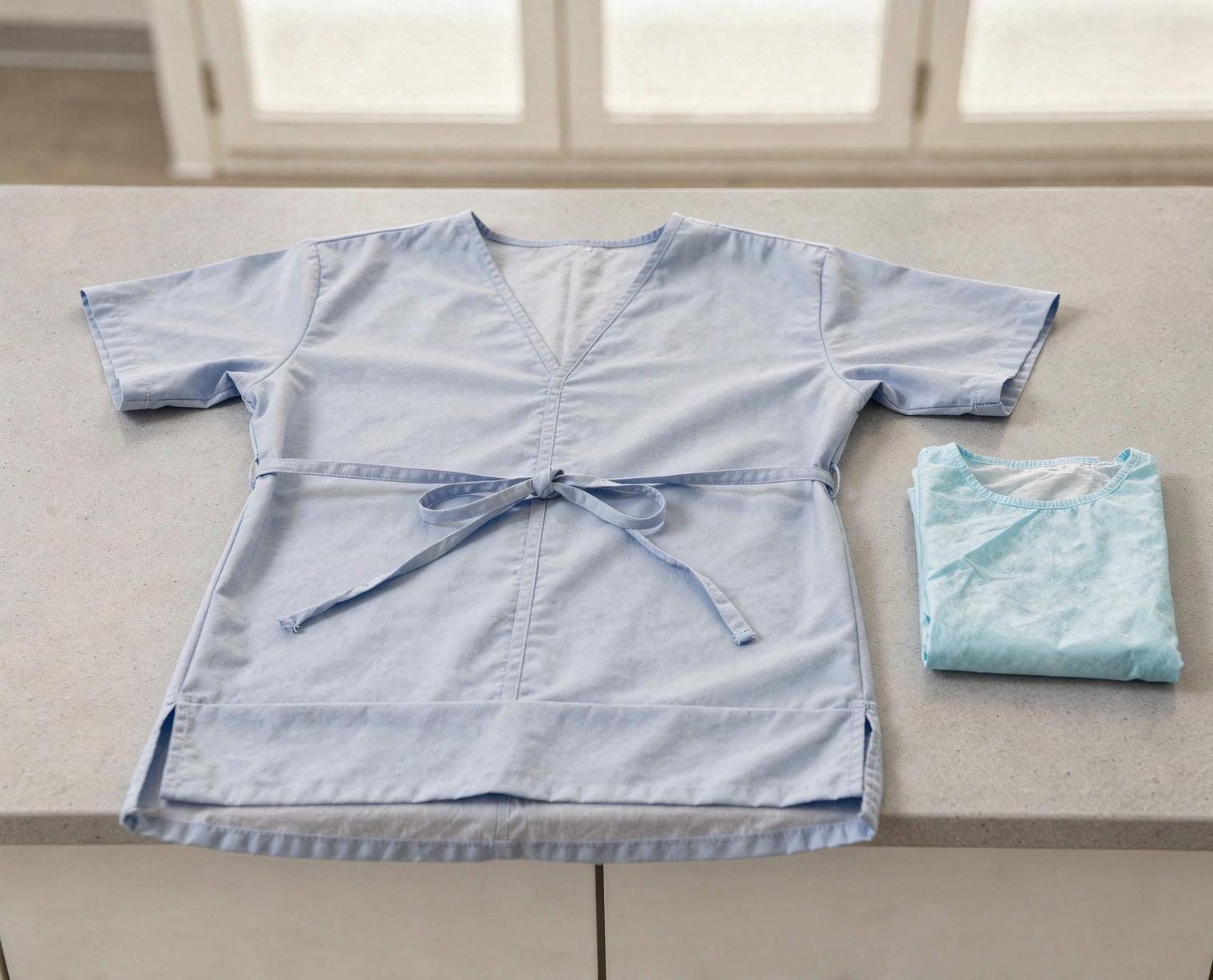
Table of contents
- What a patient gown is, and what it is not
- Types of hospital gowns for patients
- Patient gown sizes
- Reusable vs. disposable patient gowns
- Where to buy hospital gowns, and when to rent instead
- How to choose the best patient gowns for your facility
- Frequently asked questions
- Get a gown program built around your usage
Hospital gowns look like a commodity until you have to stock them. Then the questions pile up: which styles a unit or exam room really needs, how many sizes to carry, whether cloth or paper costs less per visit, and whether to buy gowns outright or rent them through a linen service. This guide answers those questions for hospitals, surgery centers, clinics and private practices, using published specs, peer-reviewed research and what we see running patient gown programs for healthcare facilities across Ohio, Indiana and Northern Kentucky.
What a patient gown is, and what it is not
A patient gown is the garment a patient wears during a stay, a procedure or an exam. Its job is access, modesty and comfort. It is not protective equipment. The ANSI/AAMI PB70 barrier levels (1 through 4) apply to surgical gowns, isolation gowns and drapes worn or used by staff, so a standard patient gown has no barrier rating and should never stand in for an isolation gown. We cover that distinction in more depth in patient gowns vs. isolation gowns.
Patient gowns do fall under FDA oversight. Under 21 CFR 880.6265, an examination gown made of cloth, paper or other material and worn by a patient during a medical exam is a Class I device, exempt from premarket notification. FDA also lists a separate "gown, patient" category as a Class II device, so the classification depends on the product's intended use and claims. Ask a supplier which one applies to the gown it is quoting.
Types of hospital gowns for patients
The table shows the main types, what each is built for and where it fits.
| Gown type | Defining features | Best fit |
|---|---|---|
| Standard patient gown | Short sleeves, open back with ties or an overlapping back panel; unisex | Inpatient units, emergency departments, general use |
| IV gown | Sleeves that open with snaps along the shoulder so the gown comes off without disconnecting a line; plastic snaps are common for imaging compatibility | Med-surg, infusion, pre-op and post-op |
| Telemetry gown | IV-style gown with a chest or lower-front pocket for a monitor | Monitored patients |
| Exam gown or cape | Lighter, shorter-wear garment; front or back opening; cloth or paper | Doctors' offices, urgent care, imaging, chiropractic and physical therapy |
| Front-opening and mammography gowns | Tie in front for full back coverage; capes cover the upper body only | Mammography, OB/GYN, women's health |
| Bariatric gown | Much wider sweep and longer length; full back overlap on some models | Any unit; essential for dignity and for a gown that actually closes |
| Pediatric gown | Scaled-down cut; infant and children's sizes | Pediatric units, children's practices, emergency departments |
Inpatient units rely on standard and IV gowns. Outpatient settings lean the other way: a doctors' office gown is worn only for the length of an exam, so exam gowns and capes do most of the work there.
Cotton vs. cotton/poly blends
Many reusable gowns are cotton/polyester blends rather than pure cotton hospital gowns. A common construction is 55% cotton and 45% polyester, the blend Medline lists for its overlap-and-tie patient gown. Some IV gowns are 100% polyester, and some women's wellness gowns use polyester/nylon knits for stretch and coverage, as shown in Medline's physician office catalog. If you want 100% cotton, confirm the fiber content on the spec sheet before you order.
Patient gown sizes
Gowns are sized by two measurements. Sweep is the full width of the gown laid open, edge to edge. Length runs from shoulder to hem. Sweep decides whether the back closes. A gown that is long enough but too narrow is the one that leaves patients exposed.
There is no universal size standard, so these published examples are reference points, not rules:
| Size class | Example sweep | Example length | Source |
|---|---|---|---|
| Standard adult (one size) | 53 to 68.5 in. | 42 to 43 in. | Phoenix Textile, Medline |
| Adult IV gown | 64 in. | 47 in. | Medline |
| 3XL | 77 in. | 43 in. | Medline |
| 10XL bariatric | 104 to 110 in. | 48 to 51 in. | American Dawn, Ursource |
Notice the spread inside "one size fits most": a 53-inch sweep and a 68.5-inch sweep are both sold as standard. If patients complain about coverage, compare the sweep on your current gown before changing anything else. For long hospital gowns, look at length in the 47- to 51-inch range.
Fit is not a minor issue. Earlier research summarized in a CMAJ Open study on hospital gown design found that 70% of patients said their gown did not fit and 72% felt exposed in it. Keeping a bariatric hospital gown and children's sizes on the shelf addresses part of that problem. Our own patient apparel runs from infant to bariatric sizes for that reason, and our patient wear line includes unisex, extra-large and children's size patient gowns.
Reusable vs. disposable patient gowns
Cloth patient gowns are built to be laundered and reissued dozens of times. Disposable patient gowns are worn once and thrown away. A paper gown in a hospital or exam room is usually tissue/poly/tissue, a three-ply sheet with a thin plastic film between two tissue layers.
| Factor | Reusable (cloth) | Disposable (paper) |
|---|---|---|
| Comfort and coverage | Soft, opaque, drapes and stays closed | Thinner; suited to short wear |
| Wear time it suits | Minutes to days | Short exams |
| Size and style range | Infant to 10XL; IV, telemetry and front-opening styles | Adult and some pediatric sizes |
| What you manage | Soiled collection, laundering, loss | Storage space, reordering, waste volume |
| Waste | Discarded only at end of life | One gown in the trash per patient |
Disposable hospital patient gowns make sense where there is no soiled linen pickup and visits are brief, or as a backup supply. For anything a patient wears longer than an exam, or sits, walks or sleeps in, cloth is the better garment.
Cost per use
The sticker price misleads in both directions. A disposable exam gown looks cheap by the piece: online case prices we reviewed worked out to roughly $0.31 to $0.90 each. Those are public listing prices, not contract rates, but they show the range. You pay that amount again for every patient, plus waste hauling.
A reusable gown costs more up front and then spreads that cost over its life. The honest formula is:
Cost per use = (purchase price ÷ actual uses before loss or retirement) + laundering and handling per use
The word "actual" matters. Manufacturers commonly rate reusable isolation gowns for 75 to 100 uses, but the authors of a life cycle study in the American Journal of Infection Control used 60 uses as a conservative figure based on laundry tracking data, because gowns get lost and damaged before they wear out. As an illustration, a gown bought for $12 and used 60 times carries about $0.20 of fabric cost per use. If it walks out the door after 10 uses, that figure is $1.20. Loss can erase the savings faster than anything else.
Published hospital figures exist for isolation gowns, not patient gowns, so treat them as directional. Carilion Clinic estimated $0.79 per use for disposable isolation gowns against $0.39 for reusable, and UCLA Health reports $3.5 million saved over the life of its reusable isolation gown program. We have not found an equivalent published study for standard patient gowns, so run the formula with your own volumes.
Environmental impact
The same caveat applies here: the rigorous life cycle assessments cover staff gowns. They are still the best evidence available on cloth versus single-use.
- Isolation gowns: over 1,000 uses, the reusable system cut energy consumption by 28%, greenhouse gas emissions by 30%, blue water consumption by 41% and solid waste by 93% to 99% compared with disposables (American Journal of Infection Control).
- Surgical gowns: reusables cut energy by 64%, greenhouse gas emissions by 66%, blue water consumption by 83% and solid waste by 84% to 87% (AORN Journal).
Both studies counted laundering. In the isolation gown study, laundry accounted for about two-thirds of the reusable system's energy use and emissions, and reusables still came out ahead because roughly 17 gowns were manufactured instead of 1,000. That also means the laundry you choose changes the result. Our plants use 0.7 gallons of water per pound of linen, against about 2.5 for a front-loading washer, and both production facilities are TRSA Clean Green certified.
Is a laundered gown really clean?
Yes, when the process is controlled. The CDC recommends that hot-water cycles wash with detergent at 160°F or higher for at least 25 minutes, or that low-temperature cycles use chemicals suited to them at the proper concentration. Accreditation adds verification on top. The HLAC standards name patient gowns among the textiles covered and call for quarterly microbial testing, and TRSA Hygienically Clean Healthcare certification requires third-party inspection and ongoing testing.
Ask any laundry for its results. Ours are tested quarterly by an independent accredited laboratory, with pathogen screening twice a year, and recent plant-specific results are available on request. Our Hospital Services plant was one of the first HLAC-accredited hospital laundry facilities, accredited in 2007, and our certifications page explains what each credential covers.
Where to buy hospital gowns, and when to rent instead
There are three realistic routes.
Buying a few gowns
If you need one or two gowns for home care or recovery, buy online from a medical supply retailer or a general marketplace. In-store options are thin. Retail stock is limited and varies, so call a local medical supply store before making the trip. Our gown programs serve healthcare facilities.
Buying patient gowns wholesale
Medical distributors and textile manufacturers sell reusable gowns by the dozen and disposables by the case. Buying bulk hospital gowns gives you the lowest unit price and full control over style. It also leaves you with everything that comes after the purchase:
- Laundering to healthcare standards, whether in-house or contracted
- Enough inventory to cover gowns in use, in the wash and on the shelf
- Replacing gowns as they are lost, stained or torn
- Tracking where the inventory goes
In-house washing has to meet the temperature and chemistry guidance above, and someone has to keep the records. We break down the equipment, labor and utility side in why you should outsource your medical laundry.
Renting through a linen service
In a rental program, the service owns the gowns. In ours, every item is rented, laundered, inspected and replaced by us. A route representative collects soiled gowns, delivers clean ones and restocks to an agreed par level on a fixed schedule. There is no capital purchase, and worn gowns are swapped out as part of the service.
The part buyers underestimate is inventory control. Because lost gowns raise cost per use, we give healthcare customers proprietary software to track their inventory and meet with them each month to review usage. Those reviews are where par levels get adjusted and loss gets spotted early. Invoices use straightforward line items, and terms for loss and replacement are written down in advance.
| Your situation | Usually the better route |
|---|---|
| Individual or caregiver needing a few gowns | Buy online or at a medical supply store |
| Practice with brief exams and no linen pickup | Buy disposable exam gowns by the case |
| Clinic, surgery center or practice using gowns daily | Rent reusable gowns |
| Hospital or multi-site system | Rent, with usage tracked by unit |
| Facility with an accredited in-house laundry and spare capacity | Buy wholesale and process in-house |
How to choose the best patient gowns for your facility
- Match styles to care. List where gowns are worn and for how long. Add IV or telemetry gowns only where lines and monitors are routine.
- Check sweep, not just the size label. Ask for measurements and try a sample on staff of different builds.
- Stock the ends of the range. A small supply of pediatric and bariatric gowns covers patients a standard gown won't fit.
- Price it per use. Include laundering, loss and waste disposal, not only the purchase price.
- Verify the laundry. Confirm HLAC accreditation or TRSA Hygienically Clean Healthcare certification for the specific plant that will process your gowns, and ask for recent test results.
- Read the loss and replacement terms. They decide what the program costs in year two.
Our medical linen vendor checklist goes further on contract terms.
Frequently asked questions
Are hospital gowns reusable?
Most are. The cloth gowns used in hospitals are made to be laundered and reissued many times. Paper exam gowns are single-use and should be discarded after one patient.
What is the difference between a hospital gown and an exam gown?
A hospital gown is designed for extended wear, with a longer cut, back closure and often snap sleeves for IV access. An exam gown or cape is lighter and meant for a short visit. It may open in the front or back, and it comes in cloth or paper.
Can custom gowns be part of a rental program?
Often, yes. Style mix, size range and specialty garments such as mammography or OB/GYN gowns can be built into a program. Ask about specific options when you request a quote.
How many patient gowns does a facility need?
It depends on census, changes per patient and delivery frequency. A rental program sets a par level for each location and adjusts it as usage data comes in, which is more reliable than a one-time estimate.
Where can I find patient gowns near me in Ohio, Indiana or Kentucky?
We rent and launder patient gowns for hospitals, surgical facilities, urgent cares and doctors' offices from production plants in Dayton and Zanesville and distribution centers in Cincinnati, Columbus and Indianapolis. Coverage varies by address, so contact us to confirm service at your location.
Get a gown program built around your usage
If you are weighing cloth against paper or buying against renting, the fastest way to a real answer is to price it with your own numbers. Tell us how many patients you see and which gowns you use now, and we will put together a patient gown program and quote to compare. Request a free quote.
Ready to get started?
Talk to our team and see how we can help.