Bar Towels vs. Bar Mops vs. Microfiber: A Guide to Restaurant Kitchen Towels
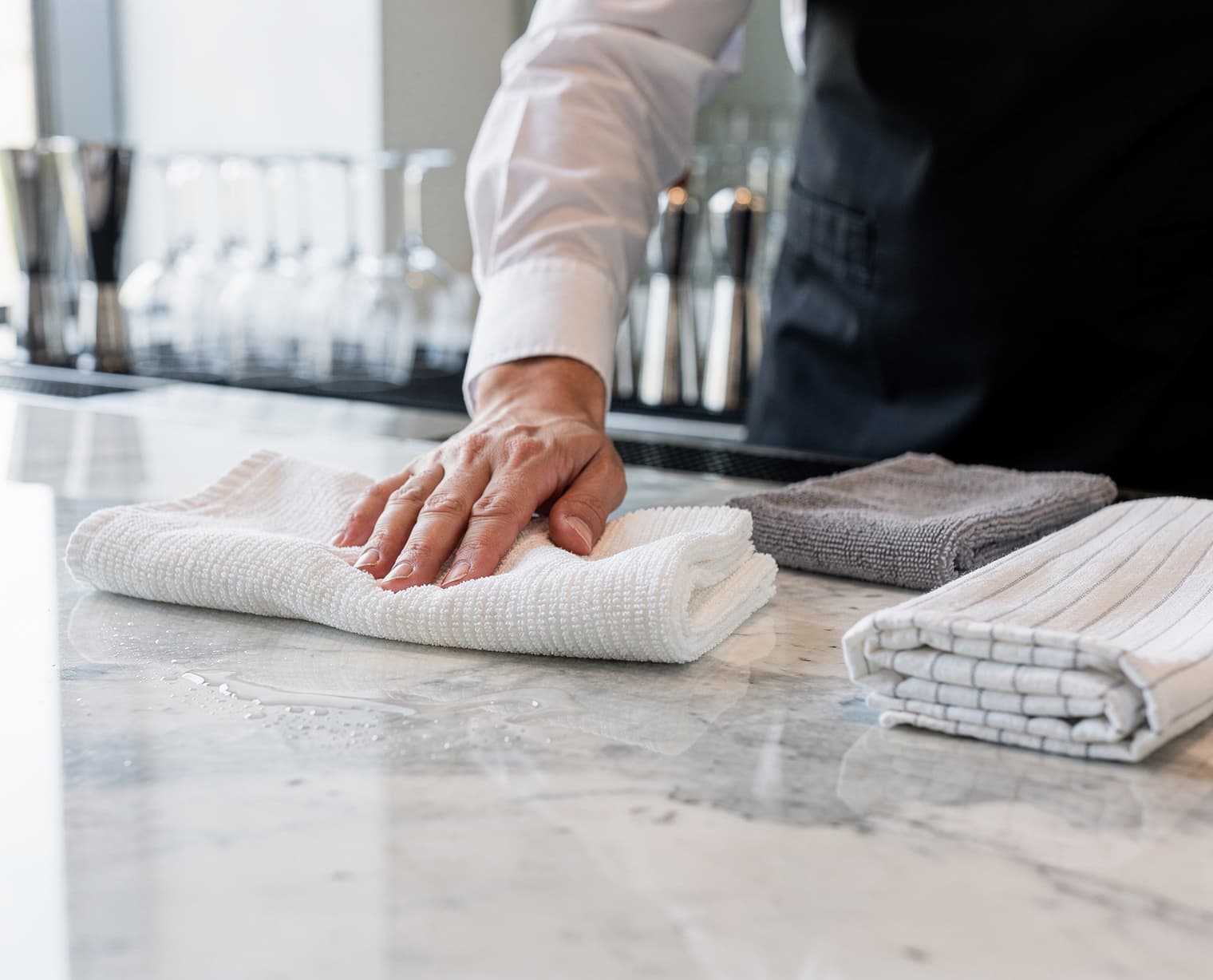
Table of contents
- What are restaurant towels called?
- What are bar mop towels?
- Bar towels vs. bar mops: is there a difference?
- Glass towels: the one towel you should not swap
- Microfiber bar towels: where they win and where they fail
- Disposable food service towels
- Restaurant kitchen towel comparison
- Color coding bar towels for food safety
- How many bar towels does a kitchen need?
- Buying bar towels in bulk vs. renting through a towel service
- Where to get bar towels near you
- Frequently asked questions
Walk into any commercial kitchen and you will find the same white cotton towel draped over a cook's shoulder, tucked into an apron string, or sitting in a bucket of sanitizer by the flat top. Most people call them bar towels. Some call them bar mops, bar rags, kitchen towels, or just "the rags." The names get used loosely, but the towels themselves are not interchangeable: a terry bar mop, a ribbed bar towel, a reduced-lint glass towel, a microfiber cloth, and a disposable food service towel each do one job well and others poorly. Here is what each type is called, where it belongs in a restaurant or bar, how the FDA Food Code expects you to handle it, and how buying bar towels in bulk compares with renting them through a towel service.
What are restaurant towels called?
Restaurant and bar kitchens generally work with five types of towel. The terms overlap, but these are the distinctions that matter when you are ordering or setting up a towel program:
- Bar mop towels (bar mops): heavyweight cotton terry towels, most commonly 16 x 19 inches, built for absorbing spills and wiping down stations. The workhorse of the kitchen and the bar well.
- Bar towels (ribbed or herringbone bar towels): a flatter, ribbed cotton weave. Lower pile than terry, so less lint and faster drying, but also less absorbent per wipe. Often used interchangeably with "bar mop," which is where most of the confusion starts.
- Glass towels (glass cloths, polishing cloths): reduced-lint towels used to polish glassware, flatware, and mirrors. Our glass towels are designed specifically for polishing glass and silverware.
- Microfiber towels: synthetic split-fiber cloths that trap fine particles and leave no lint. Best on front-of-house surfaces, stainless, and glass; a poor fit for greasy line work.
- Disposable food service towels: single-use or limited-use nonwoven wipes, usually sold on a roll or in a dispenser box. Convenient for raw-protein cleanup and jobs you never want a reusable towel touching.
There are also specialty pieces. Grill pads, which we supply as grill wipes, are thicker than a traditional bar towel and made for scrubbing commercial grills and heavy kitchen surfaces. Aprons, chef coats, and napkins are separate categories, though they travel on the same delivery truck.
What are bar mop towels?
A bar mop is a cotton terry towel with loops on both sides. The looped pile is what makes terry absorbent, which is why a single bar mop can soak up a dropped pint or a spill off the pass without smearing it around. Suppliers quote bar mop weight per dozen, and commercial grades commonly run from about 20 to 32 ounces per dozen. Heavier towels hold more liquid and tend to survive more wash cycles; lighter ones dry faster but wear out sooner.
Despite the name, bar mops are not just for bars. In a kitchen they wipe cutting boards between tasks, dry washed produce and pans, grab hot handles, and sit in sanitizer buckets as the wet wiping cloth every station is required to keep. Behind the bar they dry the well, mop up the drip tray, and keep the rail from getting sticky. If a kitchen only stocked one towel type, this would be it.
Cotton has a few honest weaknesses. Terry sheds lint, especially when new, so it is the wrong tool for polishing glass. Cotton also absorbs grease and food soil deeply, which is exactly what you want on the line but means a bar mop needs a hot, chemically correct wash to come back clean and odor-free. A kitchen that launders its own in a domestic-grade machine will notice bar mops greying and souring.
Bar towels vs. bar mops: is there a difference?
The two terms are often used interchangeably for the same cotton kitchen towel. Where they are distinguished, the difference is weave:
- Terry bar mop: looped pile on both sides, maximum absorbency, more lint, slower to dry.
- Ribbed bar towel: flat ribbed or herringbone weave, lower absorbency, less lint, dries fast, lies flat under a cutting board.
Many restaurant and bar operations run both. Terry bar mops handle wet work and sanitizer buckets; ribbed bar towels go on the pass, under boards, and anywhere a flatter, cleaner-looking towel is visible to guests. Bar mops are also sold with a colored center stripe woven in. Those stripes are not decoration. They are the easiest way to color code towels by task, which we cover below.
Glass towels: the one towel you should not swap
Glassware polished with a terry towel comes out streaky and flecked with lint, and that shows under bar lighting. A glass towel is built to leave nothing behind. Keep glass towels out of the kitchen rotation: one trip through a sanitizer bucket or a greasy wipe-down and they will not polish cleanly again. Stock them separately, launder them separately where possible, and keep the par level small but dedicated.
Microfiber bar towels: where they win and where they fail
Commercial microfiber is made from split nylon/polyester fibers. The split creates a large surface area with fine edges that lift dust, fingerprints, and film rather than pushing them around. On stainless steel, glass, laminate tabletops, menus, and host stands, a damp microfiber cloth outperforms cotton and leaves no lint.
In a working kitchen the picture changes:
- Grease loads it up. Microfiber grabs oil readily and holds it. Once saturated with fryer or sauté residue it stops absorbing water, and the oil is hard to wash out without a hot, well-formulated commercial wash.
- Heat shortens its life. Microfiber is plastic. Manufacturer care guidance from Unger warns that high heat can melt or damage the fine fibers, and that applies to a hot sheet pan or a flat top as much as a dryer.
- It cannot be laundered with cotton. The same guidance says not to mix microfiber with lint-prone items such as cotton towels, and not to use fabric softener or bleach, because both reduce its cleaning effectiveness. That means a separate wash load, separate chemistry, and lower dryer heat, which is a real operational cost in a small in-house laundry.
- It is a specialty purchase. Microfiber is justified when it is used for the right task and laundered correctly, and wasted when a cook uses it to wipe the grill.
Our recommendation is to treat microfiber as a front-of-house and specialty tool: glass polishing, tabletops, stainless, restroom fixtures, and dusting. Keep cotton bar mops on the line. We also offer microfiber towels and mop products as part of our facility services.
Disposable food service towels
Disposable nonwoven towels fill a specific gap: tasks where you do not want a reusable towel to re-enter the laundry stream. Wiping down a cutting board after raw chicken, cleaning up a broken bottle, mopping a floor spill in the walk-in, or handling blood and raw seafood at a prep station are all good candidates. Disposables are also sensible for food trucks, pop-ups, and caterers working off-site without a way to manage a sanitizer bucket and a soiled-towel bag.
They are a poor primary towel. Used for everyday wiping they add up quickly in cost and waste, they absorb less than a terry bar mop, and crews tend to burn through them. A sensible split is disposables for raw-protein cleanup and a handful of edge cases, reusable cotton for everything else.
Restaurant kitchen towel comparison
| Towel type | Material | Best for | Avoid for | Durability |
|---|---|---|---|---|
| Terry bar mop | Cotton terry | Spills, sanitizer buckets, drying, line work, bar well | Polishing glass, visible front-of-house use | High with commercial laundering; greys and sours fast in home-style washing |
| Ribbed bar towel | Cotton herringbone or ribbed | Under cutting boards, pass, hand drying, lighter wiping | Large spills | High; lower lint, faster drying |
| Glass towel | Reduced-lint weave | Glassware, flatware, mirrors | Anything greasy or wet | Long if kept out of kitchen rotation |
| Microfiber towel | Split nylon/polyester | Stainless, tabletops, glass, restrooms | Grease, hot pans, washing with cotton | Long if washed separately without softener or high heat; short if abused |
| Disposable towel | Nonwoven | Raw protein cleanup, off-site, one-off messes | Everyday wiping (cost and waste) | Single use |
Color coding bar towels for food safety
The FDA Food Code, which many state and local health codes are modeled on (check your health department's adopted version), sets out how wiping cloths have to be handled. Section 3-304.14 requires that cloths used for wiping counters and equipment be held between uses in a sanitizer solution at the concentration specified in section 4-501.114 (for chlorine, 50 to 100 ppm at the temperature and pH the Code specifies; for quaternary ammonium, the concentration on the product's EPA-registered label), that cloths used on surfaces in contact with raw animal foods be kept separate from cloths used for anything else, that cloths used for wiping food spills from tableware be kept dry and used for no other purpose, and that wet wiping cloths be laundered daily.
Color coding is the simplest way to make those rules survive a Friday rush. A workable scheme for a typical kitchen and bar:
- Red stripe: raw meat, poultry, and seafood stations only. These never leave the station and go straight into the soiled bag, or use disposables here instead.
- Blue stripe: sanitizer bucket cloths for general counters and equipment.
- Green stripe: produce and ready-to-eat prep.
- Plain white, dry: wiping food spills from tableware and carry-out containers during service, and used for nothing else.
- Gold stripe: hand drying and grabbing hot handles.
- Glass towels and microfiber: front-of-house only, stored away from the line.
The exact colors matter less than consistency. Post the scheme at the dish pit and the line, build it into onboarding, and order towels in enough of each color that nobody is tempted to improvise. If you rent, ask your route representative what color or marking options are available for task coding so each delivery matches your stations.
How many bar towels does a kitchen need?
A par level is the number of clean towels you need on hand at the start of a shift, plus a buffer for the laundry turnaround. A realistic count starts with stations: each sanitizer bucket needs a towel in it and a dry one beside it, each cook carries one or two, the dish pit uses several per shift, and the bar goes through a surprising number on a busy night. The total depends on stations, volume, and how long towels are out for laundering, which is why we count them before proposing par levels rather than guessing.
Under-stocking shows up as cooks hoarding towels, re-using a cloth past the point of hygiene, or grabbing a glass towel for the grill. When we set up a restaurant towel program, we count the stations, weekly volume, and busiest nights before proposing par levels, then review usage with the account monthly and adjust up or down. That is also where we build in extra stock ahead of events and holiday weeks rather than leaving a kitchen short.
Buying bar towels in bulk vs. renting through a towel service
Bulk bar towels are inexpensive to buy, which is why many new operators start there. The purchase price is rarely the problem. The problem is everything that follows:
- Laundering. Someone has to wash them, daily, hot enough and with the right chemistry to remove grease and kill bacteria. That means a commercial-grade washer and dryer, utilities, detergent and sanitizer, and paid hours. A domestic machine in the back hallway does not get bar mops truly clean, and they go grey, stiff, and sour.
- Replacement. Cotton bar mops thin out, fray, and stain. Owned towels get used long past the point you would want a health inspector to see them, because throwing them out costs money and nobody is tracking it.
- Loss. Bar towels walk. They end up in the trash with the floor spill, in a cook's car, and under the dumpster. Purchased inventory shrinks constantly and silently.
- Management time. Ordering, receiving, storing cases, chasing the person whose job it was to run the washer.
A bar towel service flips the model. The service owns the inventory, delivers clean towels on a set route, picks up the soiled ones, and launders them in a facility built for it. You pay a linen rate plus service charges, with replacement pricing spelled out up front. Worn towels are pulled from circulation and replaced from the service's stock rather than from your budget, though loss charges typically apply to towels that leave the system entirely, so it still pays to keep them out of the trash.
Here is how we run it. Our patented "check point" system guarantees our restaurant linen meets our quality standards, and every product is ironed, steamed, or folded before it leaves our facility. Our team also examines each piece for wear, stains, and damage and removes anything below standard from circulation. Our laundries are certified under TRSA Hygienically Clean Food Service, a standard that requires documented separation of soiled and clean goods and microbiological testing of processed textiles, so the wash process is verified rather than taken on faith. Our customers get proprietary software to track their linen inventory, a monthly usage review, and a proposal that shows the linen rate, service charges, and replacement pricing on one page, with no surprise surcharges added later. We are also TRSA Clean Green certified, using heat recovery, rinse-water reuse, and about 0.7 gallons of water per pound of laundry.
The honest exception: a very small operation, say a coffee shop or a food truck using a few dozen towels a week, can get by with purchased towels and disposables if someone is disciplined about daily hot washing. Once a kitchen has a line, a bar, and a dish pit, the labor, replacement, and loss costs are worth pricing against a rental quote. Our linen rental cost guide walks through how the pricing is structured.
Where to get bar towels near you
For restaurants and bars in Ohio, Indiana, and Kentucky, we have been family-owned since Harry Feldman founded the company in Dayton in 1931. Today we serve restaurants, bars, taverns, caterers, and banquet centers from locations in Cincinnati, Columbus, Dayton, Indianapolis, and Zanesville, with service areas that include Middletown, Bloomington, Lafayette, and the Northern Kentucky counties. The same account can carry bar mops and bar linens, glass towels, grill wipes, aprons, chef coats, napkins, and tablecloths, plus anti-fatigue floor mats and mop service for the kitchen, so one route representative covers the whole back of house.
To get a towel program quoted, send us your weekly towel count (or your best guess), the number of bar stations and cook stations, your busiest nights, and how you want towels color coded. We will come back with par levels, a delivery schedule, and itemized pricing. Request a quote or call 1 (800) 536-1000.
Frequently asked questions
What kitchen towels do restaurants use?
Restaurants typically run cotton terry bar mops as the main kitchen towel, ribbed bar towels for the pass and under cutting boards, reduced-lint glass towels for polishing glassware and flatware, microfiber for stainless and front-of-house surfaces, and disposable nonwoven towels for raw-protein cleanup. The bar mop does the bulk of the work; the others are task-specific.
Are bar towels and bar mop towels the same thing?
The terms are often used interchangeably for the standard cotton kitchen towel. Where suppliers distinguish them, "bar mop" means the looped terry version with maximum absorbency and "bar towel" means the flatter ribbed or herringbone weave with less lint.
Can microfiber replace cotton bar mops in a kitchen?
Not on the line. Microfiber excels on glass, stainless, and tabletops, but it loads up with grease, is damaged by heat, and has to be laundered separately from cotton without softener or high dryer temperatures. Use it front of house and keep cotton bar mops for cooking stations and sanitizer buckets.
How often should restaurant bar towels be laundered?
The FDA Food Code requires wet wiping cloths to be held in sanitizer solution between uses and laundered daily; dry wiping cloths must be laundered as often as necessary to keep them clean. In practice a towel that has been through a shift is soiled and should not be reused the next day regardless of what it looks like. A towel service rotates clean stock to your par level so there are fresh towels for every shift, with pickup and delivery frequency set by your volume.
Is it cheaper to buy bar towels in bulk or rent them?
Buying is cheaper on the invoice; the real comparison includes laundering labor, utilities, chemicals, replacement, and loss. Very small operations can manage with purchased towels. A full-service kitchen and bar should price those costs against a towel service quote that covers laundering, delivery, and replacement of worn goods.
Ready to get started?
Talk to our team and see how we can help.